Houtong Cat Village — what it's actually like and how to make the most of it
Setting expectations correctly
Houtong is a former coal-mining village in the Keelung River valley, about 45–55 minutes by train from Taipei Main Station. It has two things: a collection of approximately 200 rescued and sterilised cats living freely around the village, and a well-preserved piece of industrial heritage from Taiwan’s coal era that almost nobody writes about.
| Where | Houtong Station, Keelung River valley, New Taipei |
| Cost | free entry; around NT$46–55 train each way |
| Time needed | 2–3 hours |
| Getting there | TRA train from Taipei Main Station toward Ruifang |
| Best combined with | Shifen and Jiufen on the same day |
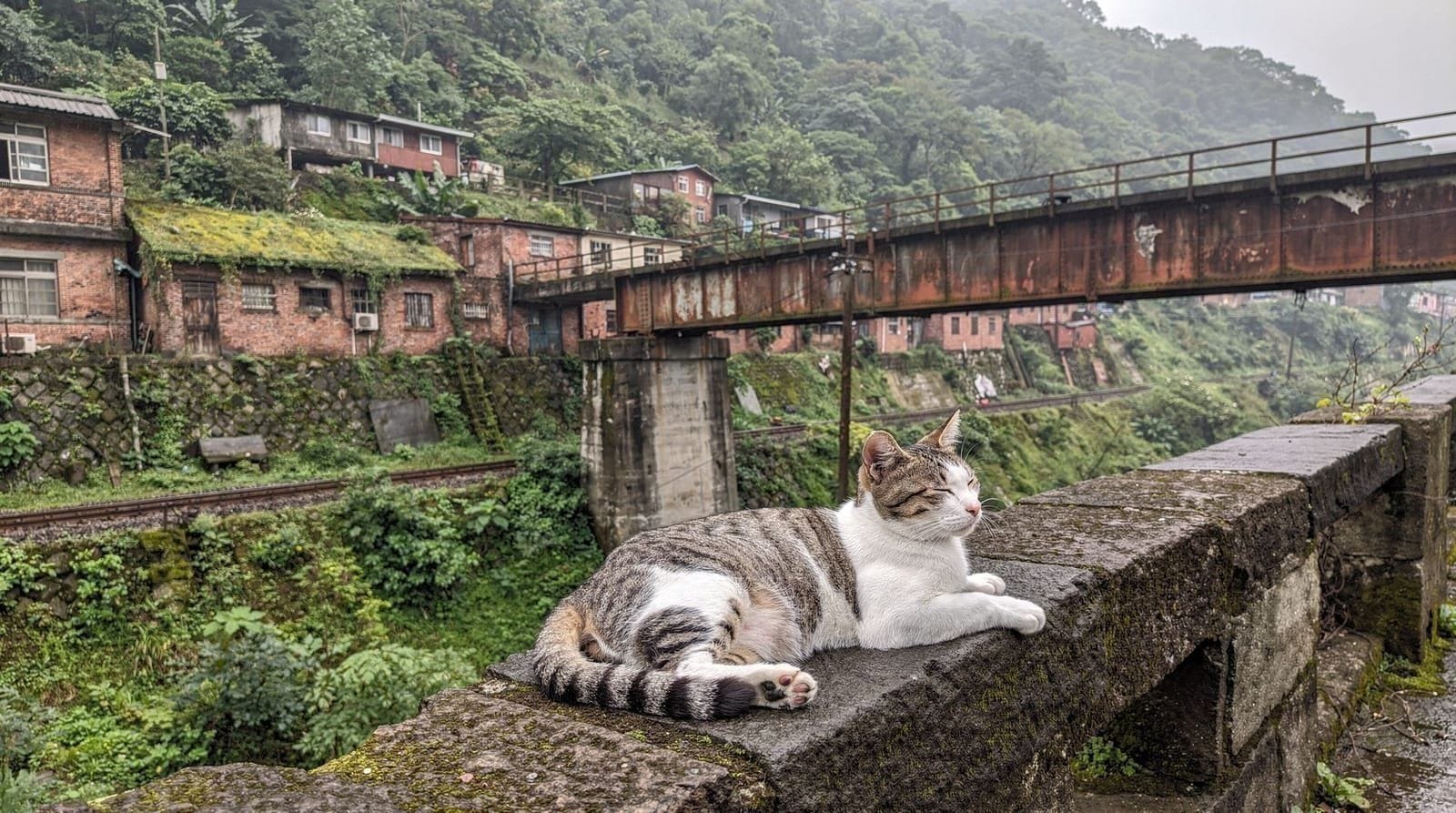
Most travel content about Houtong focuses entirely on the cats — understandably, because they’re the reason most people make the trip. But the place has a quiet, slightly melancholic character that extends beyond the feline population: old stone buildings, a suspension bridge over the river, rusted mining equipment, and a hillside neighbourhood that was once home to a few hundred miners and their families.
The cats are real. They’re mostly docile, visibly cared-for (sterilised, vaccinated, regularly fed by volunteers), and numerous enough that you’ll encounter them within 30 seconds of leaving the train station. This is not a cat café or a managed tourist attraction — it’s a village where cats have established themselves, and the community has chosen to support rather than remove them.
What to expect when you arrive
The train station at Houtong (猴硐站) is small — one platform, a ticket machine, minimal signage. Cross the bridge from the platform toward the village and you’ll immediately understand the appeal: cats sleeping on window ledges, cats sitting on staircase posts, cats watching you from above with mild indifference.
The upper village has a series of streets and old buildings that have been preserved rather than renovated. The Cat Museum (猫村懷念館), a small free exhibition space near the bridge, has old photographs of the mining community alongside the story of how the cat colony formed. It’s worth 20 minutes.
The cats’ welfare is noticeably prioritised here. Volunteers post signs asking visitors not to feed the cats outside designated areas (to avoid nutritional inconsistency), not to pick them up or disturb sleeping cats, and to use quiet voices around nervous animals. Take this seriously — the system works because residents enforce it.
Expect: sleepy cats, shaded lanes, a few small cafés serving drinks and simple food, a river walk, and the mining heritage site. Don’t expect: a polished tourism infrastructure, large souvenir shops, or a particularly long itinerary. Houtong is a 2–3 hour stop, not a full day.
The coal mining heritage: the underwritten story
What gives Houtong its atmosphere is the industrial layer beneath the cat colony. The Jinguashi and Houtong mining region was active through the mid-20th century, and the coal infrastructure that remains — the processing facility on the opposite side of the river from the village, accessible via a footbridge — is now partially preserved as a cultural site.
The Coal Mining Industry Museum (煤礦博物館) at Houtong displays original equipment, mine shaft models, and photographs from the active mining period. Entry is free. It’s not comprehensive, but for 30–40 minutes it provides context for why this valley town exists at all.
The contrast between the grim industrial past and the current cat-colony present gives Houtong a more interesting texture than the typical day-trip destination. It’s not kitsch. It’s a real place trying to find a second act.
Getting there from Taipei
Take any TRA train from Taipei Main Station toward Ruifang (the main junction for the northern mountain towns). Get off at Houtong Station — it’s one stop before Ruifang.
- Journey time: approximately 45–55 minutes
- Cost: NT$46–55 depending on train type (local or express)
- Frequency: trains run every 20–40 minutes; check the TRA app or website for the schedule
From Houtong, the village is accessed via the footbridge directly from the station. No bus or taxi needed.
Combining with Shifen and Jiufen: From Houtong, continue one stop to Ruifang Station. From there:
- Take the Pingxi Branch Line (from Ruifang, changing to the small 2-car train) to Shifen for lanterns and the waterfall (~25 min)
- Take Bus 825 or 826 from outside Ruifang Station to Jiufen (~15–20 min)
A day covering Houtong in the morning (09:00–11:00), Shifen at midday (11:30–14:00), and Jiufen in the afternoon/evening (14:30 until dark) is a realistic and well-paced combination. See the Pingxi line day trip guide for specific train timings.
Taipei: Jiufen, Shifen, Houtong cat village private day tourPractical details
Entry: Houtong village is free to enter. The Cat Museum is free. The coal industry site is free.
Food and drink: Several small cafés near the station sell drinks, ice cream and simple snacks (NT$40–80). One or two have rooftop or riverside seating. There is no large restaurant — if you need a proper meal, Jiufen (the next logical stop) has many more options.
Photography: Good light in the morning (east-facing valley). Midday is flat. Late afternoon is better but the train schedule back to Taipei is worth checking before committing to a long afternoon stay.
Weekdays vs weekends: Weekdays are noticeably quieter and more pleasant. Weekend cat interactions are constrained by the volume of visitors — the cats retreat or get overwhelmed. If you have a choice, Tuesday to Thursday mornings are ideal.
Accessibility: The station and main village streets are relatively flat. The upper neighbourhood requires some stair-climbing but is not strenuous. The coal museum side involves some uneven ground.
Is Houtong worth it if you’re not a cat person?
Honestly, probably not as a standalone destination. The mining history is interesting but thin, and the village is small. If you’re combining it with Shifen and Jiufen — which you should — it adds a meaningful layer to the day rather than being a detour.
If cats are specifically not your interest, the Pingxi line itinerary works just as well if you skip Houtong and spend more time in Shifen or at Pingxi town itself.
For the best day trip combination from Taipei that includes this area, a private car is worth considering if there are 3–4 of you — it removes the train schedule dependency and lets you control timing at each stop:
Taipei: Yehliu, Shifen, Houtong, Jiufen one-day tourCat etiquette, in more detail
The volunteer-run system at Houtong works because visitors mostly respect it, and it’s worth understanding the reasoning rather than just following signs. Feeding is restricted to designated stations because ad-hoc feeding by hundreds of visitors a week creates nutritional inconsistency and can attract pests.
Picking up cats is discouraged because even docile, human-habituated cats can be startled by unfamiliar handling, and a scratch or bite from a village cat is a real (if rare) risk. Loud voices and sudden movement scatter the cats to their hiding spots, which is its own kind of disappointment — the whole appeal is seeing them relaxed and visible. Slow, quiet movement and letting a cat approach you, rather than the reverse, gets better results and better photos.
A slower version of the visit
Most day-trip itineraries budget Houtong as a quick 45-minute stop between the train and the next town, which undersells it. A slower version — 2 to 3 hours as suggested above — allows time to actually sit somewhere quiet (there are a few benches and low walls near the upper village that make good resting points), watch the cats’ behaviour rather than just photographing them, and cross the river footbridge to the mining side without rushing. The coal museum, in particular, rewards unhurried reading — the photographs of the mining community juxtaposed against the current cat-colony scene say more about the village’s transformation than any summary can.
Comparing Houtong to other Pingxi-line stops
| Stop | Main draw | Time needed | Distance from Ruifang |
|---|---|---|---|
| Houtong | Cats + coal heritage | 2–3 hours | 1 stop |
| Shifen | Sky lanterns + waterfall | 2–3 hours | 4 stops |
| Jiufen | Old street + evening lanterns | 3–4 hours | separate bus route |
Houtong is the lightest of the three in terms of time commitment, which is exactly why it slots neatly into the morning of a Pingxi-line day rather than needing its own dedicated trip.
Frequently asked questions about Houtong Cat Village
How many cats live in Houtong?
Approximately 200 cats are registered and monitored by the Houtong Cat Village Association. The number fluctuates as new arrivals are processed (sterilised and vaccinated) and some cats pass on.
Can I pet the cats at Houtong?
You can interact gently with cats that approach you, but you’re asked not to pick them up or pursue reluctant cats. Feeding the cats outside designated areas is discouraged.
How long should I spend in Houtong?
Two to three hours is enough for the village, the cat areas, the Coal Museum and a walk along the river. It works best as the first stop on a day that continues to Shifen and Jiufen.
Is Houtong suitable for children?
Yes — the cats are gentle and the village is walkable. Children under 7 should be supervised closely around the cats. The coal museum is child-friendly with tactile exhibits.
What’s the difference between Houtong and Shifen?
Houtong is for cats and coal heritage; Shifen is for sky lantern releases and a large waterfall. They’re 25 minutes apart on the branch line and complement each other well.
Is Houtong worth visiting on its own, without Shifen or Jiufen?
It’s thinner as a standalone trip — 2–3 hours of village and museum content. It works best as the first stop on a Pingxi-line day that continues to Shifen and Jiufen.