Beitou hot springs guide — everything you need to know
Taipei: Beitou hot springs and heritage walking tour
How do I visit Beitou hot springs from Taipei?
Take the MRT Red Line to Xinbeitou station (about 25 minutes from Taipei Main). Public pools from NT$40–100; private bathhouses from NT$400 per person. Most facilities open 9:00–22:00. No advance booking needed for public pools.
Beitou is the easiest hot spring escape from central Taipei — a volcanic valley reachable entirely by MRT, with everything from a NT$40 public pool to premium resort soaking rooms packed into a 20-minute walk. This guide covers how to get there, what the three spring types actually feel like, which bathhouses are worth your money, and how to build a half-day around the springs without wasting time on mediocre options.
| Where | Xinbeitou, MRT Red Line (30 min from Taipei Main) |
| Cost | NT$40–100 public pool; NT$400–3,500 private room |
| Time needed | 2–4 hours; half-day with Yangmingshan |
| Getting there | MRT Red Line → Beitou → Xinbeitou branch |
| Best time | Weekday mornings, autumn–winter |
Getting to Beitou without the hassle
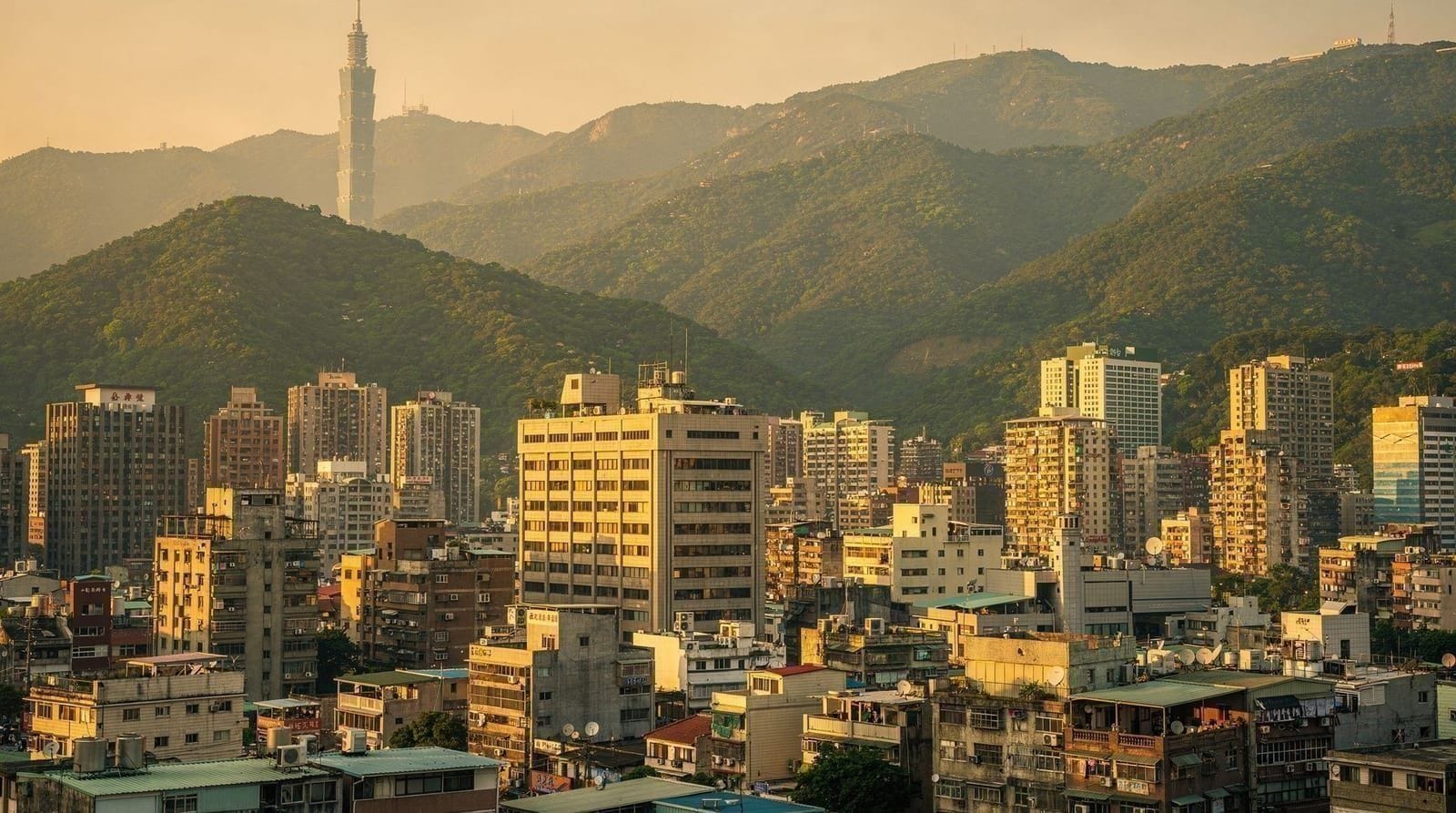
Beitou sits at the northern end of the MRT Red Line — one of the easiest day escapes from central Taipei. From Taipei Main Station, take the Red Line toward Danshui and alight at Beitou (NT$30, about 20 minutes). Switch platforms to the short Xinbeitou branch line (one stop, included in your fare) and you arrive in Xinbeitou within another 5 minutes. Total travel time from Taipei Main: around 30 minutes.
Taxis from central Taipei take 30–45 minutes depending on traffic and cost around NT$300–500. There is no practical reason to take one unless you are travelling with significant luggage or arriving very early before MRT service begins (first trains around 06:00).
From Xinbeitou MRT station, the hot spring valley is a 10-minute walk uphill along a pedestrianised riverside path past the Hot Spring Museum, Thermal Valley and clusters of bathhouses. The route is well-signposted in English.
The three zones of Xinbeitou
The spring area divides loosely into three zones along Zhongshan Road and the riverside:
Lower zone (near MRT): Millennium Hot Spring public pool, budget bathhouses, the Hot Spring Museum. Most accessible, most crowded.
Mid-valley: A mix of mid-range hotels with day-use facilities, independent bathhouses, and a few teahouses. Spring water quality varies — ask which source they use.
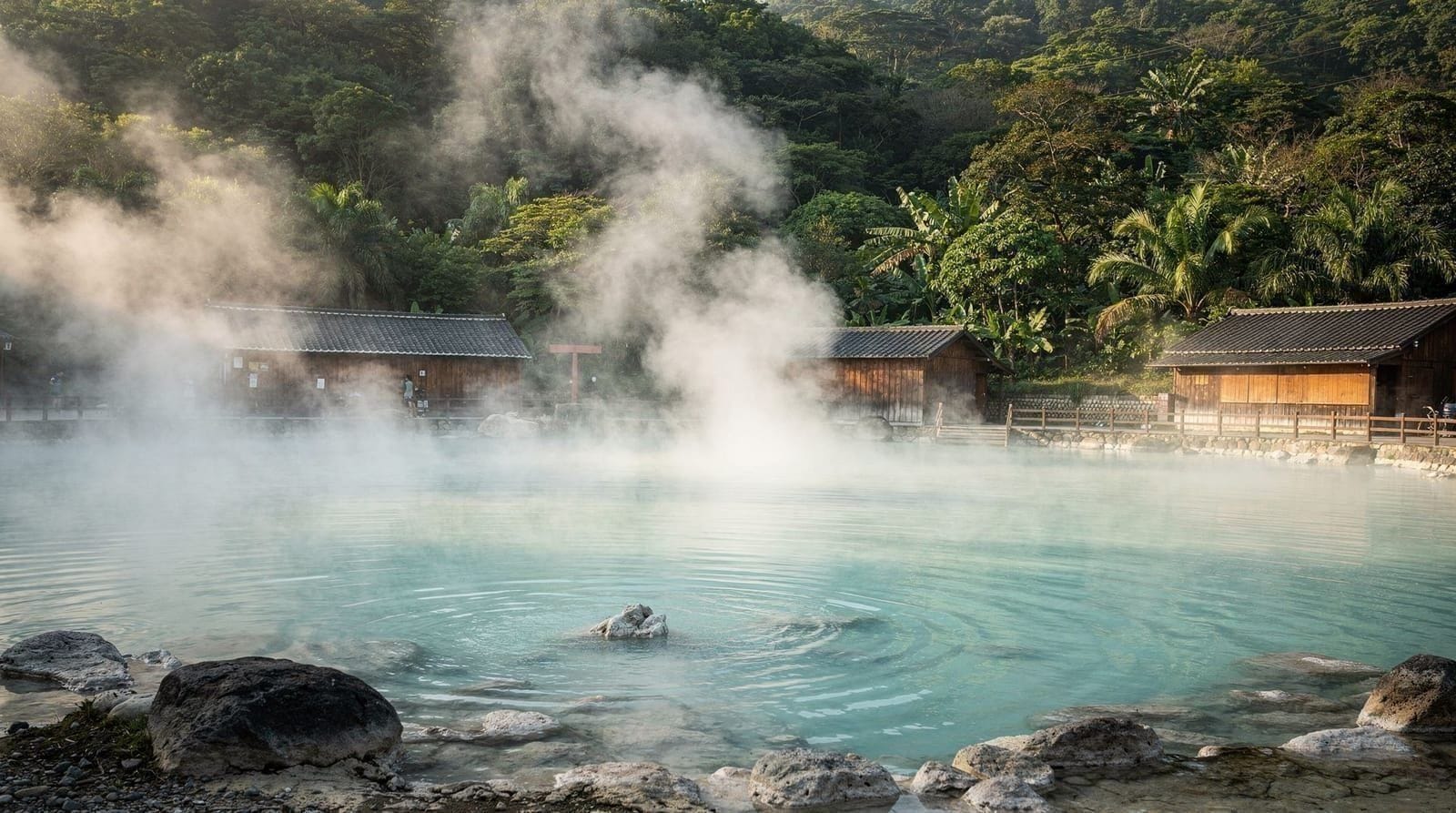
Upper valley (Thermal Valley area): The free-viewing boiling pond at Thermal Valley (Diyu Gu), high-end resort hotels, and the emerald-green sulfur springs accessible only at premium properties. The famous boiling green pond is genuinely impressive and worth seeing even if you are not bathing.
Public pools: the honest assessment
Millennium Hot Spring (Qianxi Gonggong Yuchi) This is the most affordable option: outdoor pools fed by the local white sulfur spring, admission NT$40 for adults on weekdays and NT$80 on weekends. Hours are 05:30–10:00 and 13:00–21:00 (closed Mondays, 08:00–10:00 reserved for elderly). There is no locker room storage for valuables, no towel rental, and the changing facilities are basic. Swimwear is mandatory; the pools are separated into women-only and mixed areas. Capacity limits apply and queues form on Sunday afternoons.
Verdict: genuinely good value if you treat it as a cultural swim experience. Do not expect a spa.
Thermal Valley (Diyu Gu) No bathing — this is a free-entry viewing point for the famous blue-green boiling pool, a product of the rare green sulfur spring. Temperature reaches 95°C. The area around it smells of sulfur and the colour of the water shifts through the day. Worth 15–20 minutes as part of a walk. Free entry, open daily 09:00–17:00 (Monday closed).
Private bathhouses: what to expect
Private rooms offer a soaking tub, usually seating for 2–4 people, fresh towels, and often a shower. Sessions run 40–60 minutes and cost NT$400–800 per person at independent bathhouses; resort hotels charge NT$1,000–3,000+ for two people for 60–90 minutes. The markup at hotel facilities buys you cleaner facilities and more reliable hot-water quality.
Better-value independent bathhouses to consider:
Spring City Resort (Chungtian Hot Spring Hotel) offers day-use private rooms from around NT$600 per person, fed by the white sulfur spring. It is one of the cleaner independent operators in the mid-valley.
Millennium Hot Spring Upstairs — several small private bath operators above the public pool area charge NT$400–600 for 40-minute private tubs. Quality is inconsistent; check that the tub was cleaned before the session.
Thermal Valley Beitou Hotel and similar upper-valley properties start at NT$1,200 per person for day-use private rooms using green sulfur spring water — the rarest type. These are worth considering if you are specifically chasing the emerald-green water experience.
For a guided introduction to the springs and their history before you choose a bathhouse, the walking tour covers the key sites in 2–3 hours:
Beitou hot springs and heritage walking tourThe Hot Spring Museum: history in 45 minutes
The Beitou Hot Spring Museum (Beitou Wenquan Bowuguan) is a 1913 Japanese-era public bathhouse converted into a free museum. The ground floor retains the original Roman-style tiled bath — no longer in use but intact. Upper floors cover Beitou’s geology (three spring types explained clearly in English), the history of Japanese-era spa culture in Taiwan, and rotating cultural exhibitions.
Hours: Tuesday–Sunday 09:00–17:00. Entry free. Allow 30–45 minutes. It is an ideal first stop to understand what you’re about to soak in.
Combining Beitou with Yangmingshan
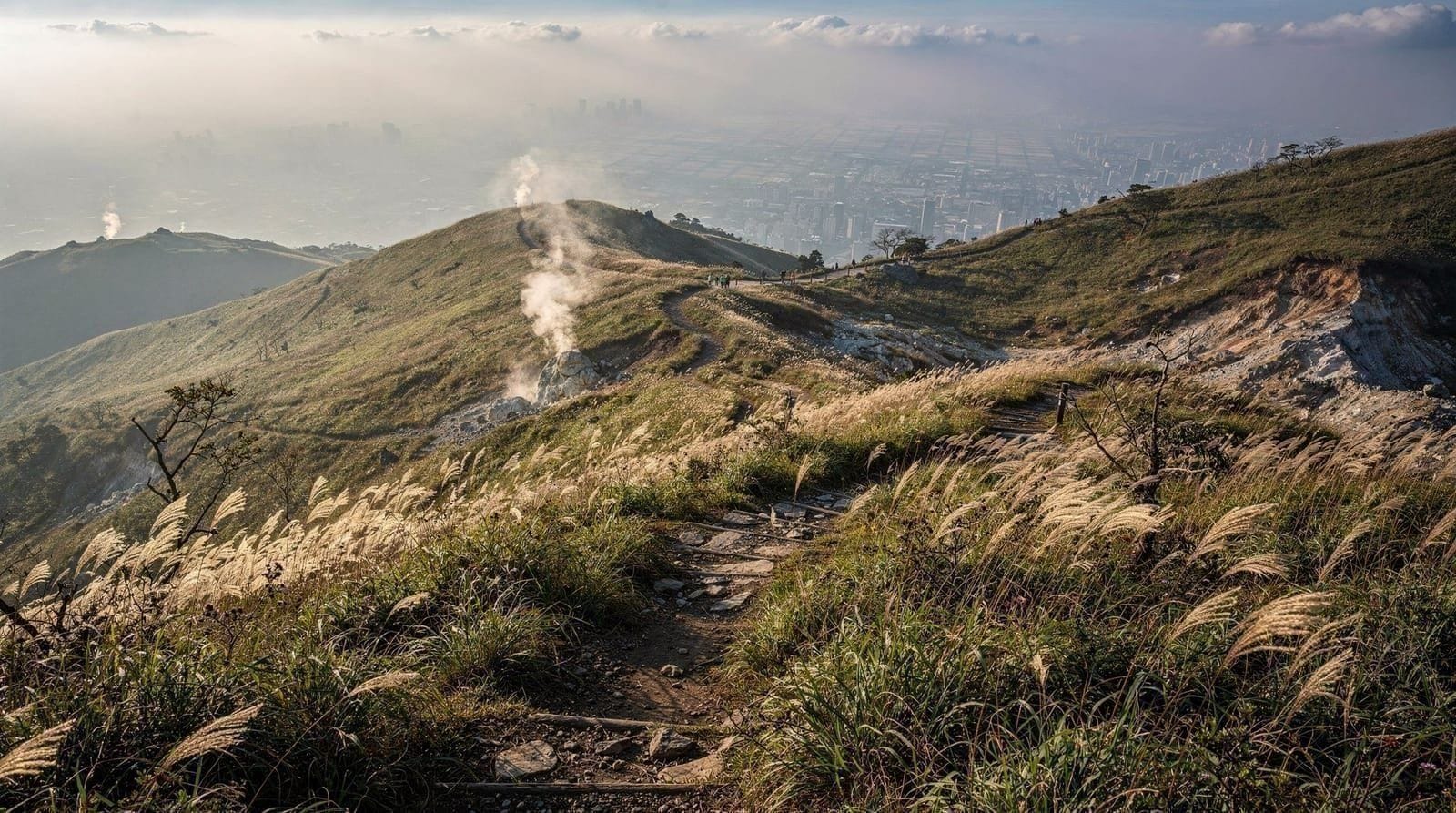
Beitou and Yangmingshan National Park are natural partners — they share the same volcanic system. The standard combined day looks like this:
- 09:00: Take MRT to Xinbeitou
- 09:30: Bus 130 or Xiao-1 from Xinbeitou MRT to Yangmingshan main recreation area (25–35 min, NT$15)
- 10:00–13:00: Hike Xiaoyoukeng or Seven Star Mountain trails (see Yangmingshan hiking guide)
- 13:30: Return bus to Xinbeitou
- 14:00–16:00: Hot spring session
- 16:30: Return by MRT
This schedule avoids peak crowds at both locations and ensures you see Yangmingshan before afternoon haze sets in.
Beitou and Yangmingshan National Park day tourEating and drinking in Xinbeitou
The pedestrian street parallel to the riverside (Zhongshan Road and its side lanes) has a solid range of options:
Noodles and beef soup: Several traditional Taiwanese beef noodle shops operate near the MRT exit, prices NT$100–160 for a bowl. These are the right pre-soak or post-soak carbohydrate option.
Teahouses: A few small tea shops operate in the upper valley near Thermal Valley. Prices NT$100–180 for a pot of oolong. Not the refined teahouse experience of Jiufen or Maokong, but pleasant enough.
Convenience stores: Two 7-Elevens and a Family Mart are within 5 minutes of the MRT station — practical for snacks and drinks before your soak.
What to skip: The sit-down restaurants aimed at tour groups near the museum tend toward overpriced set menus. Eat beforehand or stick to the street stalls.
Seasonal notes
Autumn and winter (Oct–Feb) are the best seasons for hot springs: air temperatures are cool, which makes the contrast with hot water more enjoyable. Beitou is popular in winter precisely because the pools feel especially restorative.
Summer (Jun–Aug): The spring water remains hot year-round, but soaking in 40°C water when ambient temperature is 33°C is less appealing to most visitors. Weekday mornings are cooler. Typhoon season (July–September) can interrupt bus routes to Yangmingshan.
Cherry blossom season (late January–March): Yangmingshan blooms and visitor numbers spike across the whole area. Book private bath rooms ahead if combining with a weekend Yangmingshan visit during peak bloom.
Practical checklist
- MRT: Red Line → Beitou → Xinbeitou branch (30 min from Taipei Main, NT$30)
- Public pools: NT$40–100, swimwear mandatory, own towel required
- Private rooms: NT$400–800/person (independent), NT$1,000–3,000 (resort), 40–90 min
- Museum: Free, Tue–Sun 09:00–17:00
- Thermal Valley: Free to view, Tue–Sun 09:00–17:00 (closed Monday)
- Best time: Weekday mornings; autumn–winter for optimal contrast
- What to bring: Swimsuit, towel, flip-flops, no metal jewellery
For a comparison with Wulai and Jiaoxi to decide which springs to prioritise for your trip, see the Beitou vs Wulai vs Jiaoxi comparison guide.
If you want to pair hot springs with Tamsui’s riverside for a day:
Beitou and Tamsui combined day tourWhat most guides won’t tell you
A few honest caveats for Beitou:
The sulfur smell is noticeable. This is real volcanic spring water. If you are sensitive to sulfur odours, the smell may be off-putting near Thermal Valley and at green-spring facilities. It dissipates in the open air fairly quickly.
Green spring water at affordable bathhouses is rare. Most budget and mid-range bathhouses use white sulfur spring water (clear, no dramatic colour). If you specifically want the emerald-green water, you will need to pay resort prices or visit Thermal Valley (viewing only).
Private room turnover is fast. Sessions are typically 40–60 minutes. Staff will knock at the door when your time is up. If you want to extend, agree on this before you start.
Parking is terrible on weekends. If you are coming by car or taxi, plan extra time. The MRT is significantly more reliable on busy days.
For general hot spring etiquette in Taiwan — what to do before entering, tattoo policies, and tipping norms — see the full hot spring etiquette guide.
The geology behind Beitou’s springs
Understanding why Beitou has springs helps you choose the right facility. The Datun Volcanic Group, which also forms Yangmingshan National Park, is geologically young — the last eruptive activity was approximately 280,000 years ago, and the system remains hydrothermally active. Groundwater percolates down through faulted rock, heats against residual magmatic heat, and rises back to the surface chemically altered.
The three spring types in Beitou are the product of different depths, pathways, and rock chemistry:
White sulfur spring (baishui): The most widely distributed type in Xinbeitou’s commercial bathhouses. Temperature 47–55°C at the source. Clear water, mildly acidic (pH 4–5), mild sulfur content. Most budget and mid-range bathhouses tap this type.
Green sulfur spring (qingshui): Significantly rarer and hotter — up to 142°C at the geothermal source, cooled before use. Contains radium, one of the three known radium springs in the world. The characteristic emerald-green colour comes from native sulfur particles in suspension. Only accessible at Thermal Valley (viewing) and a handful of high-end resort hotels that have drilled specifically for this source. The slight radioactivity is at levels considered safe and in Japanese spa culture has historically been promoted as therapeutic.
Sodium bicarbonate spring (carbon spring): Found at lower elevations in the valley, used by a smaller number of facilities. Clear, odourless, and alkaline (pH 7.5–8.5). The softest-feeling water of the three types. Often described as producing particularly smooth skin after soaking.
This geological variety — three distinct spring types within a 2km area — is part of what makes Beitou exceptional. No other hot spring district in Taiwan offers all three types within walking distance.
Hotels with day-use hot spring access
If you want a more polished experience than the independent bathhouses, several of Beitou’s hotels offer day-use access to private spring rooms or pools without an overnight stay.
Caesar Park Beitou: Upscale resort hotel with outdoor rooftop spring pools. Day-use packages from approximately NT$800–1,500 per person. White sulfur spring. Advance booking recommended on weekends.
Radium Kagaya Taipei: Premium Japanese-style hot spring hotel specifically known for offering green sulfur spring water (radium spring). Day-use private rooms from approximately NT$2,000–3,500 for two people per session. Located near Thermal Valley. This is one of the few places you can actually soak in the famous emerald-green water.
Beitou Hot Spring Resort: Mid-range hotel in the lower valley. Day-use private rooms available on weekdays for approximately NT$800–1,200 per couple. White sulfur spring. Clean facilities, less premium than the upper-valley hotels.
Note: hotel day-use prices change seasonally and by day of week. Call or check the hotel website before visiting — online booking is not always available in English.
Neighborhood walk: from MRT to Thermal Valley
The 20-minute walk from Xinbeitou MRT to Thermal Valley is worth doing slowly. Here is what you pass:
Xinbeitou Park: A small Japanese-era park immediately in front of the MRT exit. The covered pedestrian bridge over the canal is the main approach to the upper valley.
Beitou Hot Spring Museum (Wenquan Bowuguan): At the 5-minute mark on your right, the 1913 Japanese public bathhouse is now a free museum. The 1st floor shows the original Roman-style tiled bath in its preserved state. The 2nd floor has geology exhibits, historical photos from the Japanese era, and a reading room overlooking the park. Worth 30–45 minutes.
Plum Garden (Mei Ting): A 1920s Japanese-style wooden villa a short detour uphill from the museum, now operated by the New Taipei City government as a cultural space. Free entry when open. The garden is particularly scenic in late January when the plum trees bloom.
Thermal Valley (Diyu Gu): At the top of the valley road, this is the free-viewing boiling pond. Temperature 95°C. The vivid blue-green colour shifts through the day with light and steam conditions. A wooden walkway circles the perimeter. Allow 15–20 minutes. Closed Mondays.
Paper Domes (Beitou Culture Centre area): Near Thermal Valley, a cluster of small cultural venues, art spaces, and teahouses in renovated or repurposed Japanese-era buildings. If you have time after Thermal Valley, a short detour here shows another layer of Beitou’s heritage.
Day planning: the ideal Beitou visit in four hours
If you have a half-day to dedicate to Beitou, this sequence works well:
- 09:30: Arrive at Xinbeitou MRT
- 09:35–10:20: Hot Spring Museum (free, 45 min)
- 10:25–10:45: Walk through Xinbeitou Park and along the canal path
- 10:50–11:10: Thermal Valley viewing (free, 20 min)
- 11:15: Check into a private hot spring room at a mid-valley bathhouse
- 11:20–12:20: Soak (60 min session)
- 12:30: Walk back to Xinbeitou MRT via riverside path, grab lunch from street vendors (NT$80–150)
- 13:15: Depart Xinbeitou on MRT
Total cost: approximately NT$700–1,100 per person (museum free, Thermal Valley free, NT$400–800 for private bath, NT$30 MRT, NT$100–150 lunch).
For the full Taipei trip context, see best day trips from Taipei, Beitou, Yangmingshan hiking, Wulai, Maokong gondola, Taipei MRT guide, Taipei in 3 days itinerary, EasyCard guide, and the Taipei travel budget guide.
Beitou on a rainy day
Rain is not a reason to skip Beitou — if anything, a wet, cool day is when hot springs feel best. The Hot Spring Museum, Plum Garden and most private bathhouses are all indoors or covered, and the riverside walk to Thermal Valley has a roofed section near the museum. The one thing that changes is footwear: bring water-resistant sandals rather than sneakers, since the pedestrian path gets slick. If a typhoon warning is in effect rather than ordinary rain, check that your chosen bathhouse is open — some upper-valley resorts close outdoor pools during high wind, though indoor private rooms usually keep operating. For general typhoon-season planning across Taipei, see best time to visit Taipei.
Health considerations before you soak
Sulfur hot springs are not risk-free for everyone. Anyone with heart conditions, uncontrolled high blood pressure, or who is pregnant should check with a doctor before a full-body soak — the heat load on the cardiovascular system is real, especially in private rooms where the water runs hotter than public pools. Avoid soaking after drinking alcohol; the combination of heat and alcohol causes dizziness and has led to fainting incidents at Beitou bathhouses. Limit sessions to 10–15 minutes at a time with breaks, drink water before and after, and exit immediately if you feel lightheaded. Open cuts or skin infections should stay out of shared public pools — the mineral content does not sterilise the water.
Accessibility and travelling with limited mobility
The MRT and Xinbeitou branch line are both step-free with elevators at every station. The riverside path from Xinbeitou MRT to the Hot Spring Museum is paved and gently graded, manageable for wheelchairs and strollers. Beyond the museum, the path toward Thermal Valley climbs more steeply and has some uneven sections. Millennium Hot Spring’s public pool has step access into the water rather than a lift, which is worth knowing in advance. Resort hotels in the upper valley (Radium Kagaya, Caesar Park) have the most accessible private-room facilities, with level entry and grab rails, though it is worth calling ahead to confirm specifics for your needs.
Frequently asked questions about Beitou hot springs guide — everything you need to know
How far is Beitou from Taipei city centre?
What is the water like in Beitou hot springs?
Are there public hot spring pools in Beitou?
Do I need a swimsuit for Beitou hot springs?
What time is Beitou least crowded?
Is the Beitou Hot Spring Museum worth visiting?
Can I combine Beitou with Yangmingshan in one day?
What should I bring to Beitou hot springs?
Top experiences
Bookable activities with verified prices and instant confirmation on GetYourGuide.