Longshan Temple guide — Taipei's most atmospheric temple
Taipei: S origin Longshan temple Taiwan cultural tour
Is Longshan Temple worth visiting in Taipei?
Yes — Longshan Temple is one of the most actively worshipped temples in East Asia, not just a tourist attraction. Come early morning (before 10am) or on a festival evening to see it at its most genuine. Entry is free, it is two minutes from the MRT, and even 30 minutes here gives a strong impression of Taiwanese religious culture.
Longshan Temple is the single most rewarding free thing to do in old Taipei — a functioning, actively worshipped temple rather than a museum piece, two minutes from an MRT exit. What follows covers its history, what to actually look for inside, and how to time a visit so it feels like the real thing rather than a tour-bus stop.
| Where | 211 Guangzhou Street, Wanhua — Longshan Temple MRT, exit 1 |
| Cost | Free (incense TWD 20–50 if buying outside) |
| Time needed | 30–45 minutes, longer with the surrounding district |
| Getting there | MRT Blue Line, 2-minute walk from the station |
| Best time | Early morning (6–9am) for genuine worship atmosphere |
History of Longshan Temple
Longshan Temple (龍山寺 — Dragon Mountain Temple) was founded in 1738 by settlers from Fujian Province who brought a fragment of a Guanyin statue from the Longshan Temple in Jinjiang, China. The name was kept in honor of that original institution.
The temple has been destroyed and rebuilt multiple times: damaged in a typhoon in 1815, renovated repeatedly through the 19th century, and severely bombed by Allied forces in 1945 (which aimed at the nearby Wanhua railway station). The 1945 bombing destroyed much of the main hall while the Guanyin statue reportedly remained undamaged — a fact that deepened the temple’s spiritual significance for local worshippers.
The current structure is predominantly a reconstruction completed in the 1950s, with significant additions in the 1970s and 1980s. The craftsmanship is exceptional: the dragon columns in the front courtyard are 1920s originals that survived the bombing.
Wanhua and the origins of Taipei
Longshan Temple sits in Wanhua (萬華), which was historically called Manka (艋舺 in Taiwanese) — a word derived from the Ketagalan indigenous language meaning “canoe” or “small boat,” a reference to the river trade that originally defined the settlement. Before the Han Chinese arrived in the early 18th century, this stretch of the Danshui River was Ketagalan territory.
The first Han settlers — primarily Hokkien-speaking Fujianese from the Tong’an and San-i county groups — arrived around 1709–1720. By the 1730s, the settlement had grown enough to justify a formal temple, and Longshan was founded in 1738 as the community’s spiritual and civic center. The temple functioned as both a religious institution and a de facto community hall — disputes were mediated here, oaths sworn, guild arrangements formalized.
Wanhua remained Taipei’s most important commercial district until the 1850s, when inter-clan conflict (the Ting-Chiang Incident of 1853, an armed confrontation between Fujianese migrant groups) displaced many residents northward to found the Dadaocheng commercial district. Wanhua’s commercial dominance diminished, but the temple’s religious significance only grew — it became a site of continuity through political change, wars and reconstruction.
Understanding this context makes Longshan Temple more than a photogenic attraction. It is the oldest institution of a city that was itself founded only in the 18th century — and it is still functioning in the same location, serving the same spiritual needs, that it was built to address.
The 1944 Allied bombing and the Guanyin miracle
On November 11, 1944, Allied aircraft bombed the Wanhua area targeting the railway yard adjacent to the temple. The bombing destroyed much of the main hall of Longshan Temple. According to accounts from surviving worshippers and temple records, the incense burner and the main Guanyin statue remained undamaged amid the ruins of the surrounding hall.
This story — whether literally true or embellished through retelling — became central to the temple’s postwar identity. The physical survival of the statue was interpreted as divine protection, and the reconstruction that followed in the late 1940s and 1950s carried particular intensity as a result. Some of the craftsmen brought in for the reconstruction were from Fujian Province; their work on the carved stone elements, roof ridges and interior ceiling represents some of the finest traditional temple craftsmanship produced in the postwar period.
The 1920s dragon columns that survived the bombing are still identifiable by their different color and surface texture compared with the postwar replacements. This palimpsest — original 1920s work alongside 1950s reconstruction alongside 1970s–80s additions — is part of what makes the temple visually interesting on extended examination.
What to see inside the complex
Main gate and front courtyard
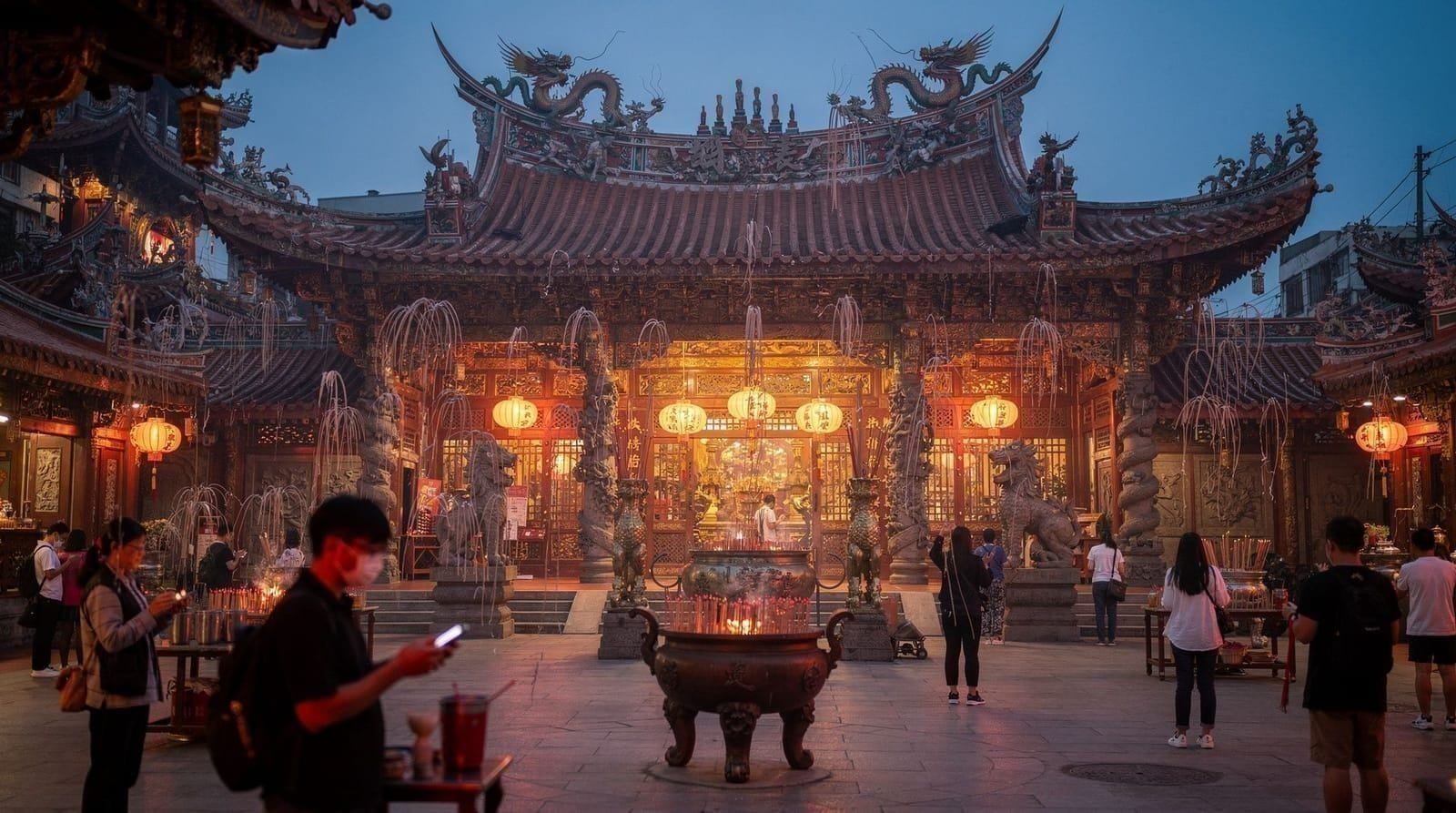
The ceremonial gate is the most photographed element of the temple — carved stone lions, red lacquer pillars and elaborate eave carvings. The two stone dragon columns flanking the gate date to the 1920s renovation and are among the finest examples of traditional stone carving in Taipei.
The courtyard has a large incense burner (ding) in the center where worshippers burn paper offerings. The smoke and the constant presence of people praying creates the atmosphere that makes this temple distinctive.
Main hall (Guanyin)
The central hall enshrines Guanyin (觀音菩薩), the Bodhisattva of Compassion — depicted here in a formal seated posture with attendants. This hall is the most actively worshipped space in the temple; during morning prayers, the density of incense smoke and the sound of bells and wooden fish drums makes a strong impression.
Flanking the main altar are paintings depicting scenes from Buddhist and Taoist cosmology. The ceiling above the altar is an intricate coffered construction — look up.
Rear hall (Taoist deities)
The rear hall is actually a separate building dedicated to Taoist gods — Guan Di (god of righteousness and wealth, popular with merchants), Mazu (Matsu, goddess of the sea, patron of maritime traders and fishermen), the God of Medicine, and several others. The contrast between the Buddhist front hall and the Taoist rear hall illustrates Taiwan’s blending of religious traditions.
The God of Marriage (Yue Lao — 月老) has a specific altar in the rear section that is notably popular with single Taiwanese in their 20s and 30s seeking romantic fortune. The scene around this altar on weekday evenings is candid and moving.
The dragon columns
Twelve stone dragon columns surround the main hall exterior — 12 because the founding community came from 12 families. The columns carved in the 1920s were saved from the 1945 bombing; the others were repaired or replaced. The difference in patina between original and restored is visible on close inspection.
Longshan Temple cultural tour — contextualizes the rituals, deities and history with a guideCheck availabilityJiaobei divination: how it works
One of the most distinctive practices at Longshan Temple — and at Taiwanese folk religion temples generally — is jiaobei divination (擲筊, zhijiao), also called moon blocks or crescent blocks. The blocks are two comma-shaped pieces of wood or bamboo, flat on one side and rounded on the other.
The system works as follows: a worshipper kneels before an altar, states their name, address, age and the question they are asking the deity, then throws the two blocks onto the floor. Three outcomes are possible:
- Shengbei (聖筊): one block flat-side up, one rounded-side up. This is a “yes” — the deity agrees with your proposal or confirms your question.
- Yinbei (陰筊): both blocks flat-side up. This is a “no” — the deity disagrees, or says the question is not ready to be answered.
- Xiaobei (笑筊): both blocks rounded-side up. This is ambiguous — the deity is laughing, suggesting the question is too certain (you already know the answer) or not yet ready to be asked.
A single shengbei is rarely enough for an important question; most worshippers throw three times to confirm a consistent answer. The blocks are available freely at the temple — they sit in baskets near the main altars. Visitors are welcome to use them, and if you observe quietly first and mimic the posture and sequence, no one will object.
Yue Lao and the romantic fortune ritual
The God of Marriage altar (月老, Yue Lao — literally “Old Man Moon”) in Longshan’s rear hall is one of the most visited spots in the entire temple complex on weekday evenings. The deity is depicted as an elderly bearded man carrying a book and a red string — the string that in folk legend ties together the ankles of people destined to meet.
The ritual at Yue Lao’s altar is specific: after incense offerings and jiaobei to confirm the deity is listening, petitioners typically write their own name, date of birth and preferred attributes of a partner on slips of red paper, which are placed in offering envelopes. The red string charms sold at the temple (TWD 50–100, €1.40–2.80) are then carried as a connection to the prayer.
The demographic around this altar — predominantly Taiwanese women and men in their late 20s and early 30s, visiting alone or with close friends, earnest rather than performative — is one of the more unexpectedly moving things to observe in Taipei. This is not a tourist display.
Ghost Festival and Moon Festival at Longshan
The Ghost Festival (中元節, Zhongyuan) falls on the 15th day of the 7th lunar month (typically August). During Ghost Month — the entire 7th lunar month — the gates of the afterlife are traditionally believed to open, and the spirits of the dead return to visit the living. Longshan Temple hosts major ceremonies throughout this period.
On the Ghost Festival itself, offerings are laid out in front of the temple — food, paper goods, incense — for the wandering ghosts. The scale of the ceremony at Longshan is one of the largest public religious events in Taipei. Street activity around the temple intensifies throughout the month with smaller neighborhood ceremonies.
The Mid-Autumn Festival (中秋節) in September/October has a distinctly Taiwanese character that may surprise visitors: the traditional mooncake exchange is present, but the dominant cultural practice in Taiwan is outdoor barbecuing with family. The parks around Longshan Temple fill with families grilling on portable stoves on the festival evening — a tradition that emerged in Taiwan in the 1980s and has no equivalent in mainland Chinese Mid-Autumn celebrations.
Longshan Temple Square and its social life
The open plaza in front of Longshan Temple (accessible from Guangzhou Street) has its own social life independent of the temple itself. In the mornings, elderly Wanhua residents gather here for chess, conversation and morning exercise. The Longshan Tunnel (捷運龍山寺站地下街), the underground shopping passage below the square, is a gathering spot for Taipei’s older homeless population — a frankly acknowledged aspect of Wanhua’s social complexity that guidebooks sometimes omit.
Wanhua has a reputation as Taipei’s rougher inner-city district — it is not dangerous in any meaningful sense for tourists, but it is noticeably less polished than Da’an or Xinyi. This is part of its character. The neighborhood around the temple rewards slow walking: the side streets between Guangzhou Street and the river have traditional tea shops, cheap breakfast diners and herbal medicine vendors that have not changed substantially in decades.
Kangding Road and the traditional medicine district
The streets immediately west of Longshan Temple — particularly Kangding Road and Xichang Street — form one of Taipei’s last intact traditional medicine and herbal goods districts. Shop fronts here display open drawers of dried herbs, roots, insect-derived medicines and specialty ingredients used in both traditional Chinese medicine and Taiwanese home cooking.
Song He Tang (松鶴堂), on Xichang Street, has been operating since the 1940s. The shop stocks several hundred varieties of dried herbs in a system of labeled wooden drawers; staff can advise on preparations for common ailments. Prices for basic dried herbs (goji, dried chrysanthemum, licorice root) start at TWD 50–100 per portion (€1.40–2.80).
The Xichang Street morning market (active 5am–noon) sells fresh produce, live seafood and prepared foods to the surrounding residential community. It is several degrees more authentic than the tourist-facing night markets — breakfast options include bowl noodles (TWD 50–70/€1.40–1.95) and rice congee (TWD 60–80/€1.65–2.20).
Qingshui Temple and the Wanhua temple network
Longshan Temple is the largest but not the only significant temple in Wanhua. Qingshui Temple (清水巖祖師廟, at 81 Kangding Road) is a 10-minute walk northwest and is dedicated to Qingshui Zushi — a Sung-dynasty Buddhist monk from Fujian’s Anxi County who is venerated particularly by Hokkien communities. The temple’s founding in 1787 makes it among the oldest in Taipei.
The Anxi settlers who founded Qingshui Temple were part of the same Fujianese migration waves that founded Longshan — and the two temples represent different clan and regional affiliations within that community. Understanding this helps explain why a city the size of Taipei has hundreds of temples: each settlement wave brought its own deity associations and founding institutional loyalties.
Visiting both on the same morning takes under an hour combined and gives a clearer picture of Wanhua’s religious landscape than Longshan alone — Qingshui’s smaller scale and quieter atmosphere are a useful contrast to Longshan’s density of activity, and the walk between them passes through the everyday texture of the neighbourhood rather than a curated tourist route.
A full Wanhua day itinerary
A logical sequence for a day based around Longshan Temple:
7am: Arrive at Longshan Temple for morning prayer atmosphere. Incense smoke, chanting, local worshippers. 30–45 minutes.
8am: Breakfast at one of the traditional diners on Kangding Road (congee, scallion pancakes, soy milk). TWD 80–120 (€2.20–3.35).
9am: Bopiliao Historic Block (剝皮寮) — 10-minute walk north via Kangding Road. The preserved shophouse row (Qing and Japanese periods) is free. 30–45 minutes.
10am: Qingshui Temple — 5-minute walk from Bopiliao. 20 minutes.
10:30am: Walk north through Wanhua toward Dadaocheng — Kangding Road to Dihua Street is a 20-minute walk, or 2 MRT stops.
Afternoon: Dadaocheng for fabric market, dried goods, food at Yongle Market. Then best temples in Taipei for the broader temple network.
Evening: Huaxi Street Night Market (active from 5pm, 5-minute walk from Longshan Temple). Lower key than Shilin or Raohe but authentic — see taipei night markets guide for comparison.
Visiting tips
Best time to visit
Early morning (6–9am): Authentic. Local worshippers — retirees, market vendors before work, students before school — conducting their daily ritual. The light through the incense smoke is extraordinary. Very few tourists at this hour.
Weekday afternoon (1–4pm): Quieter, good for photography and slower exploration without crowds.
Festival evenings: Guanyin’s birthday (19th of the 2nd lunar month, typically February–March), the Ghost Festival (7th lunar month, August–September) and Chinese New Year’s Eve see the temple at its most theatrical. These draw large local crowds and minimal tourist groups.
Avoid: Weekend afternoons from 1–4pm, when tour groups from cruise ships and day tours visit simultaneously. The temple does not close or crowd-control, so it becomes difficult to move.
Photography etiquette
Photography is permitted inside the temple — flash photography should be avoided in the main hall (it disturbs worshippers). Selfies in front of the altar during active prayer sessions are inappropriate; stand to the side. The exterior, courtyard and dragon columns are excellent for photography at any time.
Incense
Joss sticks are provided at a table near the main entrance — free to take. The sequence for a proper visit: light incense at the main gate burner, then proceed clockwise through the halls, presenting offerings and bowing at each altar. You do not need to follow this sequence as a visitor, but observing it in progress is illuminating.
Visiting with children
Longshan Temple works well for children who are old enough to understand that it is a functioning religious space rather than a theme attraction. The dragon columns and the stone lion statues at the gate are tangible and interesting. The jiaobei divination blocks are something children can try under guidance. Younger children respond well to the sensory experience — incense, bells, the visual density of the altars — though it can be overstimulating.
See taipei with kids for practical logistics on family visits to temples and other cultural sites.
Visiting solo vs with a guide
A solo, self-guided visit works well if you’ve read up on the layout beforehand — the main hall, rear hall and dragon columns are clearly signed, and this guide covers the context you’d otherwise need explained. What a self-guided visit misses is the finer detail: which specific carvings depict which legends, the precise etiquette sequence for jiaobei, and the social context of who’s praying to which deity and why. A guided visit fills that gap efficiently if it’s your only temple stop in Taipei; if you’re visiting several temples (see best temples in Taipei), the context carries over and a guide becomes less essential after the first one.
The surrounding Wanhua district
Longshan Temple sits in Wanhua, Taipei’s oldest district — settled in the 18th century before most of the city existed. The streets surrounding the temple retain a flavor of old Taipei that the more modern districts have lost.
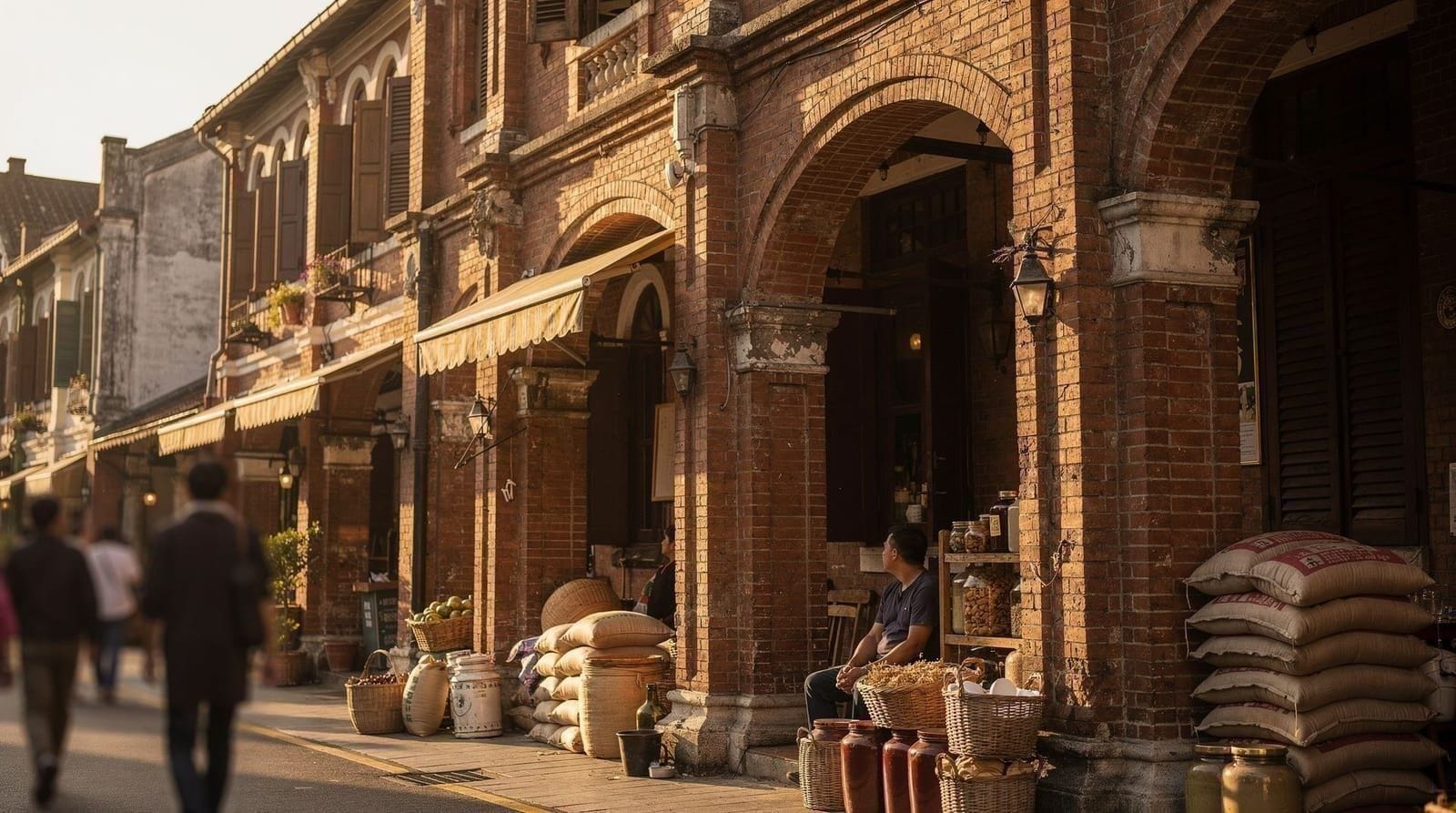
Bopiliao Historic Block (剝皮寮歷史街區): 500m north of the temple, accessible on foot via Kangding Road. A preserved row of Qing and Japanese-period shophouse buildings with stone arcades. Used for cultural exhibitions and film shoots. Free to enter and explore. Strongly recommended for 30 minutes before or after the temple.
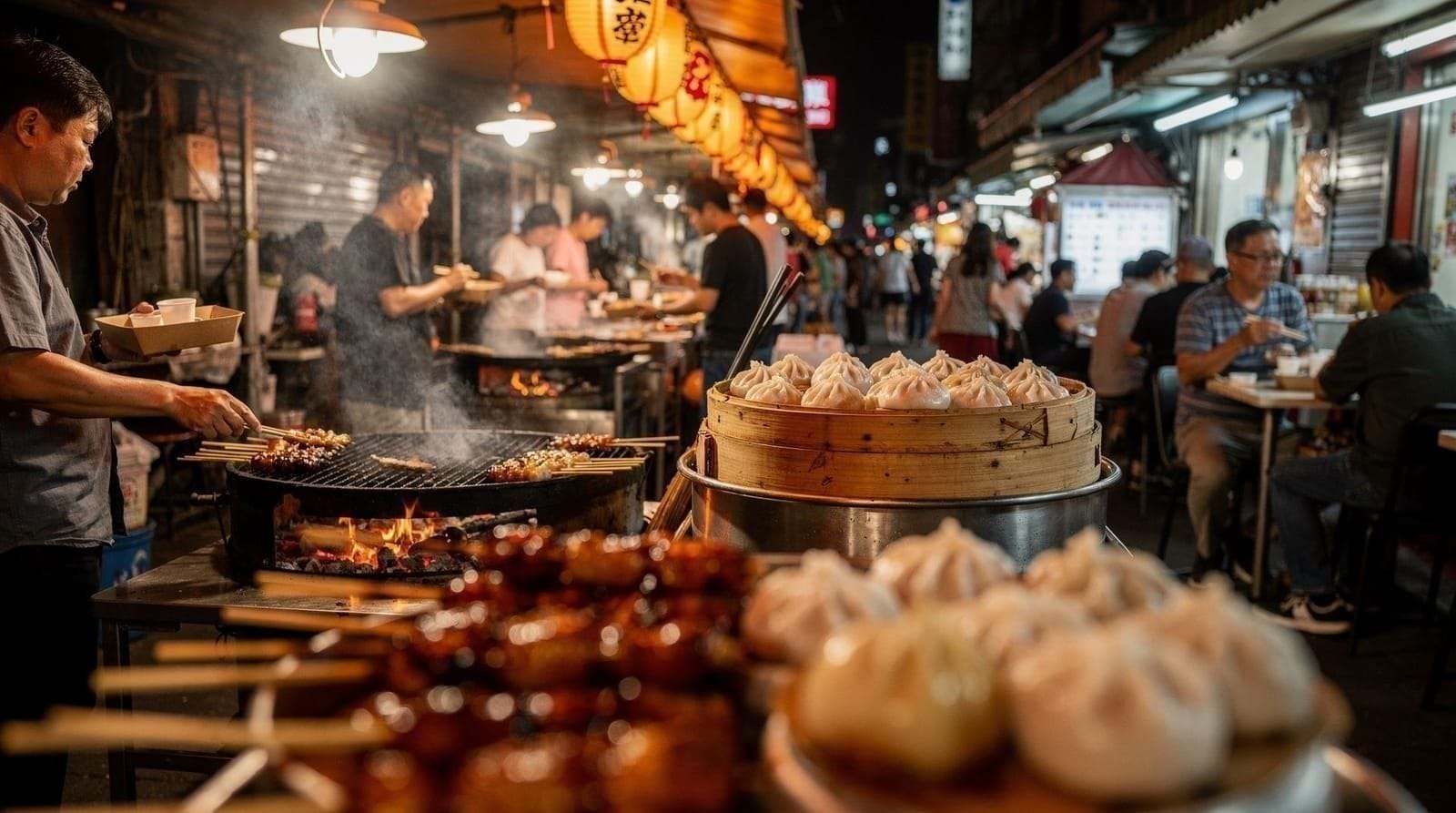
Huaxi Street Night Market: 250m northeast of the temple, active from 5pm. One of Taipei’s oldest night markets — more gritty and local than Shilin or Raohe, with traditional medicine vendors, snake wine (medicinal, now rare), and basic street food at rock-bottom prices.
Traditional herbalist street: The lanes between Longshan Temple and the Danshui River have a concentration of traditional Chinese medicine shops and herbal tea vendors — a different texture from the commercial streets of Da’an or Xinyi.
Walking tour combining Longshan Temple, Dihua Street and Taipei 101Longshan Temple and other Taipei temples compared
Longshan is the most visited temple in Taipei but not the oldest or the largest:
| Temple | District | Founded | Dedication | Entry |
|---|---|---|---|---|
| Longshan Temple | Wanhua | 1738 | Guanyin + Taoist | Free |
| Guandu Temple | Guandu | 1712 | Mazu | Free |
| Bao’an Temple | Datong | 1760 | Baosheng Dadi | Free |
| Xingtian Temple | Zhongshan | 1967 | Guan Di | Free |
| Confucius Temple | Datong | 1879 | Confucius | Free (closed Mondays) |
For a complete overview of which temples to prioritize, see best temples in Taipei. For broader trip planning, see the taipei first-timer guide and taipei neighborhoods guide.
How Longshan compares for a first-time temple visit
If Longshan is the only temple you’ll visit in Taipei, it’s a strong single choice — it combines historical depth, active worship, and easy access better than any alternative. If you have time for two, pairing it with Xingtian Temple in Zhongshan gives a useful contrast: Xingtian is younger (founded 1967), simpler in layout, and known for its distinctive fatuan (spiritual cleansing) ritual performed by temple attendants — a different flavour of Taiwanese folk religion from Longshan’s older, more architecturally layered complex. Neither replaces the other; together they show the range of what a “temple visit” can mean in Taipei.
Getting there and practical logistics
Address: 211 Guangzhou Street, Wanhua District, Taipei MRT: Longshan Temple Station (Blue Line), exit 1 — 2-minute walk Phone: +886 2 2302 5162 Hours: Daily 6am–10pm Entry: Free
Using the MRT guide and an EasyCard is the recommended approach for getting around Wanhua — the Blue Line connects Longshan Temple to Ximending (1 stop east) and to Zhongxiao Fuxing for transfers to the Red Line in about 15 minutes.
Nearest food: Huaxi Street Night Market (5 min walk), traditional diner row on Kangding Road (breakfast, 5am–noon) Nearest convenience store: 7-Eleven on Guangzhou Street, 100m from the gate
The Ximending and Wanhua destination page covers the broader district context. Combine the temple with the Dadaocheng guide for a full day in old Taipei.
Taipei old town walking tour — covers Longshan, Wanhua and the historic coreCheck availabilityCommon misconceptions worth clearing up
“It’s a tourist attraction, not a real temple”: The opposite is true. Longshan sees more daily worship activity than almost any other Taipei temple; tourists are a minority presence even at midday. Treating it purely as a photo backdrop misses what makes it distinctive.
“You need to know the rituals to visit respectfully”: You don’t. Standing quietly to the side, not using flash near active prayer, and dressing reasonably modestly covers the etiquette bar. Nobody expects visitors to perform the jiaobei or incense sequence correctly on a first attempt.
“One quick loop is enough”: The main hall alone can be seen in 10 minutes, but the rear hall, the Yue Lao altar, and the dragon column details reward a slower 30–45 minute visit. Rushing through misses most of what makes the temple worth the trip in the first place.
Frequently asked questions about Longshan Temple guide — Taipei's most atmospheric temple
How do I get to Longshan Temple by MRT?
What are Longshan Temple's opening hours?
Is there an admission fee at Longshan Temple?
What gods are worshipped at Longshan Temple?
What should I wear at Longshan Temple?
Can I participate in the prayer rituals?
When is Longshan Temple most crowded?
What is near Longshan Temple?
Top experiences
Bookable activities with verified prices and instant confirmation on GetYourGuide.