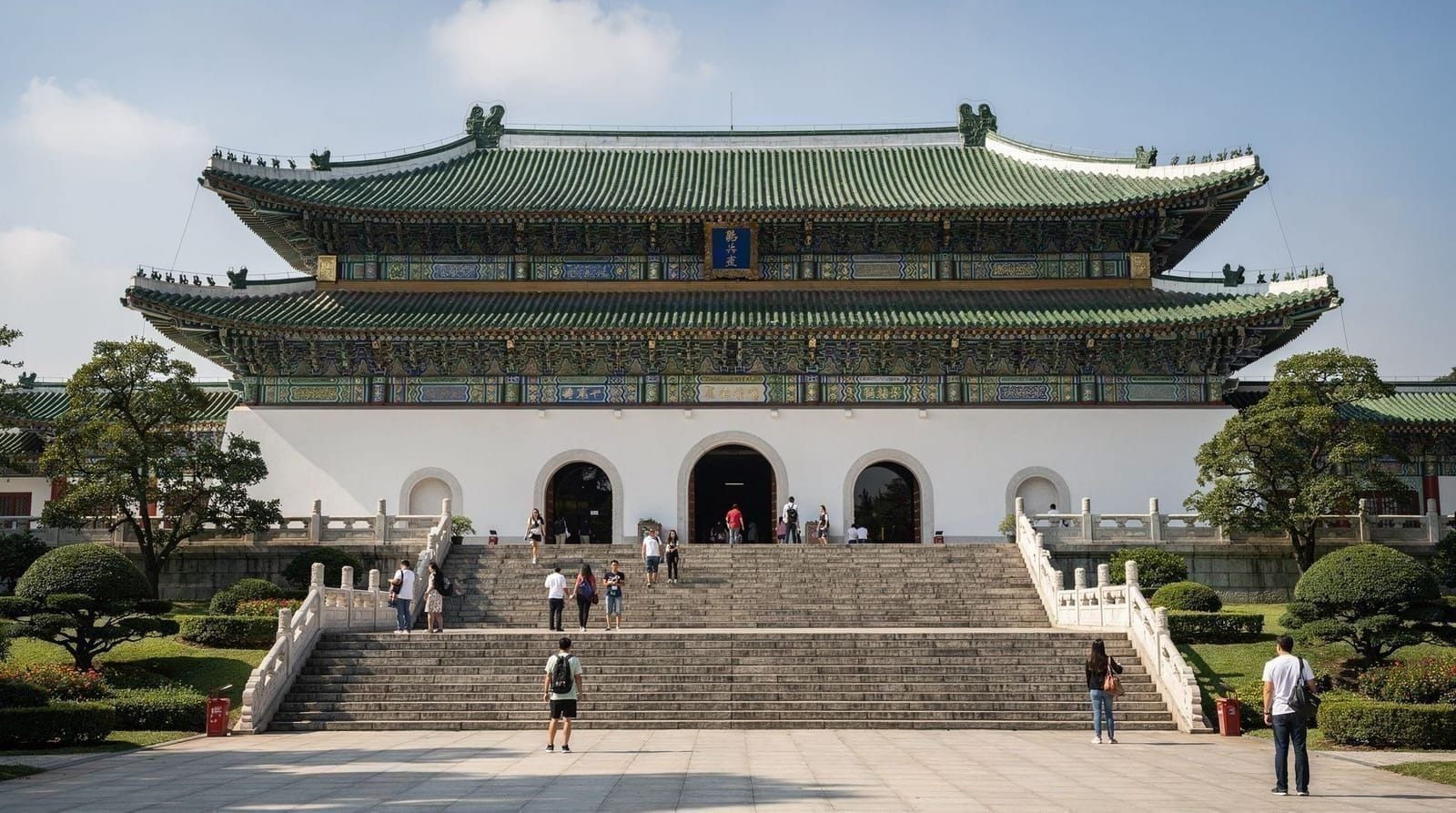
National Palace Museum guide — Taipei's world-class collection
National Palace Museum: Taiwan National Palace Museum e ticket
Is the National Palace Museum worth visiting in Taipei?
Yes — it is one of the world's great art and artifact collections. The 700,000 objects span 8,000 years of Chinese history and culture, including pieces evacuated from Beijing's Forbidden City that were never returned to the mainland. Even a 2-hour focused visit covers the most significant works; 4 hours allows real depth. Admission is TWD 350 (€9.70).
Why this collection is extraordinary
The National Palace Museum (國立故宮博物院) holds approximately 700,000 objects from the Chinese imperial collections — assembled over millennia by successive dynasties, concentrated particularly in the Ming (1368–1644) and Qing (1644–1912) periods.
What makes the collection unique is its provenance: these objects were part of the Forbidden City’s imperial treasury in Beijing until 1933, when the Chinese nationalist government began evacuating them to prevent seizure by Japan. They were moved again in 1948 during the Chinese Civil War — evacuated to Taiwan as the Communist forces advanced — and installed in this purpose-built museum in Taipei in 1965.
This means the National Palace Museum holds the bulk of the Chinese imperial collection while the Palace Museum in Beijing holds the buildings. Neither is complete without the other, but for portable objects — jade, bronze, ceramics, calligraphy, paintings, lacquer — the Taipei museum is the definitive institution.
| Where | Shilin District, about 6km north of central Taipei |
| Cost | Around TWD 350 (€9.70) adult; free for ages 17 and under; ROC citizens 65+ free (not foreign tourists) |
| Time needed | 2 hours highlights only; 4–6 hours comprehensive |
| Getting there | MRT Red Line to Shilin, then bus 255/304 (around 15 min total) |
| Best time | Weekday mornings 9–11am, before tour groups arrive |
The evacuation story
The full evacuation narrative is more complex and dramatic than the standard summary suggests. The first packing began in 1933 as Japanese forces seized Manchuria — 13,491 crates of objects were removed from the Forbidden City and moved to Shanghai. In 1937, as Japanese forces approached Shanghai, the crates were split into three convoys and dispersed to Nanjing, Hanzhong and southwest China.
During the war years (1937–1945), parts of the collection were stored in temples, bank buildings and a salt mine in Emei, Sichuan Province, a cave-reinforced warehouse in Leshan, and a tobacco warehouse in Chongqing. Despite the Japanese occupation of much of eastern China, none of the major convoys were captured or significantly damaged.
After the war, the collection was returned to Nanjing. Then, as the Chinese Civil War turned decisively in the Communists’ favor, three naval shipments moved selected portions of the collection to Taiwan: the first in December 1948 (722 crates), the second in January 1949 (3,502 crates), and the third in February 1949 (1,248 crates). The objects were initially stored in a sugar refinery in Taichung, then in purpose-built storage facilities, before the museum building in Taipei’s Shilin district opened in 1965.
The selection of what to ship in those three voyages — made under political and logistical pressure in a matter of weeks — shapes the collection visitors see today. The objects brought to Taiwan tend to be the most portable and the highest-density-of-value: jade, small bronzes, ceramics, documents, calligraphy. The large furniture, architectural elements and bulk of the bronze collection remained in Beijing.
The collection: what to prioritize
Jadeite cabbage (翠玉白菜) — Gallery 304
The most visited object in the museum. A piece of jadeite that is naturally bicolored — green and white — carved in the late Qing dynasty (Guangxu period, 1875–1908) to represent a Chinese cabbage with two insects (katydid and locust). The carving exploits the natural color boundary in the stone so the white represents the stalk and the green the leaves.
It was brought to Taiwan from the imperial collection and is believed to have been a dowry gift for a Qing princess. The object itself is about 18cm tall — smaller in person than most visitors expect. Queue for the specific gallery can be 10–20 minutes on busy days.
Meat-shaped stone (肉形石) — Gallery 304
Adjacent to the jadeite cabbage and equally famous: a piece of jasper (banded chalcedony) whose natural layering of red, orange and brown mimics the appearance of a braised pork belly slice. The stone was drilled at the surface to further enhance the illusion of fat and skin texture. It requires no artistic imagination to see the resemblance — it genuinely looks like food.
Both objects are in Gallery 304 on the third floor. Go directly there on arrival if these are your priority — crowds build throughout the day.
National Palace Museum e-ticket — skip the ticket desk queueMao Gong Ding bronze cauldron (毛公鼎)
Western Zhou dynasty, approximately 850–800 BCE. A three-legged bronze ritual cauldron notable for the inscription inside the interior — 499 characters of ancient Chinese script documenting a royal command. The longest bronze inscription known to exist. On the 1st floor, Bronze Age galleries.
The text is translated in the accompanying display — it documents a royal appointment and oath of loyalty. The object is not visually dramatic compared with the jade and ceramics, but its historical significance is exceptional.
The bronze collection beyond Mao Gong Ding
The museum holds two other major bronzes that deserve attention alongside the Mao Gong Ding. The Da Ke Ding (大克鼎) and Da Yu Ding (大盂鼎) are both Western Zhou ritual cauldrons of comparable historical weight — the three are collectively called the “three great ding” of Chinese bronze scholarship. The Da Yu Ding’s inscription (291 characters) documents a royal gift of slaves and land — a window into the social structure of the Zhou royal court around 1000 BCE.
The broader Bronze Age section (ground floor, Galleries 102–110) contains approximately 3,000 bronze objects from the Shang through Han dynasties. For visitors with a background in art history or archaeology, this section is among the finest collections of its kind in the world.
Song dynasty ceramics (Sung Ru ware)
The most important Song dynasty objects in the museum are the imperial Ru ware ceramics from the Northern Song period (960–1127) — a grayish-blue glaze called “sky after rain” (雨後天青). Only 91 pieces of Ru ware are known to exist worldwide; the National Palace Museum holds 21, more than any other institution.
They are displayed in Gallery 202 (2nd floor, ceramics section). The forms are simple — small bowls, brush washers, plates — and the aesthetic is deliberately minimal. The color shifts under different lighting conditions. This is the section most likely to interest people who already have some knowledge of ceramic history.
Imperial lacquerware
The Ming dynasty lacquer collection (Galleries 210–212) is among the strongest sections of the museum and among the least visited by first-time tourists focused on the jade and ceramics. The most impressive pieces are the carved red lacquer (剔紅) objects from the Xuande and Yongle reigns — trays, boxes, vases and furniture covered with layer upon layer of red lacquer (some pieces have 100+ layers), into which elaborate scenes of landscapes, figures and flowers are carved. The depth and subtlety of the carving is difficult to appreciate at first glance; spend at least 15 minutes in this gallery.
Gallery 214 contains a large lacquer throne with associated furniture from the Qing imperial court.
The ivory concentric sphere
In the carved ivory gallery (Gallery 308), one of the most technically extraordinary objects in the museum: a sphere carved from a single elephant tusk that consists of 17 concentric layers, each able to rotate independently, each carved with openwork floral patterns through which the inner layers are visible. The sphere is approximately 15 cm in diameter.
How this was made is genuinely uncertain. The technique was a guild secret and was lost — later attempts to replicate the construction have not reached the same number of layers. Current scholarly understanding involves initial casting in a soft material and carving from the inside out, but the exact process remains debated. The sphere dates to the Qing dynasty, probably 18th century.
Calligraphy and painting collection
The museum holds 10,000 paintings and calligraphy works from Chinese imperial collections. Rotating exhibitions display a fraction at any given time. The most famous individual work is Gu Hongzhong’s “Night Revels of Han Xizai” (韓熙載夜宴圖), a 10th-century painting — though it is not always on display. Check the museum’s current exhibition schedule online before your visit.
Ancient Chinese artifacts: bronzes, jade, lacquer
Level 1 (ground floor) covers the oldest material — Shang and Zhou dynasty bronzes, Neolithic jade ritual objects (bi discs, cong tubes). This section is less crowded and more interesting for anyone with a background in archaeological history.
The rotating display policy
Only approximately 1% of the museum’s 700,000 objects are on display at any given time. The remaining 99% are in climate-controlled storage, rotated through exhibitions according to conservation requirements and curatorial programming. This means:
- The permanent galleries change their specific contents every 3–6 months for most objects; the jadeite cabbage, meat-shaped stone and Mao Gong Ding are on permanent display
- Special exhibitions (requiring a supplement ticket of TWD 100–200/€2.80–5.55) rotate quarterly and often feature thematic groupings from storage not normally accessible
- Checking the museum’s exhibition calendar before you visit is worthwhile — you may time your visit to catch a special exhibition of particular interest
The museum’s website (npm.gov.tw) lists current and upcoming exhibitions in English.
How to plan your visit
Duration recommendations
| Priority level | What to see | Time needed |
|---|---|---|
| Highlights only | Jadeite cabbage, meat-shaped stone, Mao Gong Ding, 2–3 ceramics galleries | 1.5–2 hours |
| Core collection | Above + Song ceramics, imperial treasures galleries, one painting exhibition | 3–4 hours |
| Comprehensive | All permanent galleries + current special exhibition | 5–6 hours |
Practical tip: The museum has a clear gallery numbering system. Pick up a floor plan at the information desk (level 1 main entrance) and mark the 5–6 galleries you want. The building is large but logically organized.
Best time to visit
Weekday mornings (9–11am): The museum opens at 9:00am. First two hours are significantly less crowded — the famous objects in Gallery 304 have short or no queues. Most tour groups arrive between 10am and 2pm.
Avoid: Chinese public holidays (especially National Day in October and Chinese New Year period), summer Saturdays, and any day that cruise ships are in Keelung (tour groups arrive at the museum around 10–11am).
Lunchtime (noon–1:30pm) sees a slight crowd thinning as tour groups eat — a good time to revisit busy galleries.
Guided National Palace Museum tour — English guide provides context that self-guided visits missCheck availabilityVisiting with children
The National Palace Museum can work well for children if the visit is structured around specific objects rather than gallery-by-gallery coverage. The most reliably engaging objects for children are the jadeite cabbage (the insects on the leaf are the hook), the meat-shaped stone (the food resemblance is immediately obvious and funny to most ages), and the ivory concentric sphere (the “how did they do that” question engages children who are interested in puzzles or engineering).
The museum offers a children’s activity sheet (available at the information desk) with a treasure-hunt format that guides families through key objects with age-appropriate questions. It is available in English and makes the visit significantly more focused for ages 7–12.
Younger children (under 6) typically do better with a maximum 60–90 minute visit covering just the highlights gallery before the concentration lapses. See taipei with kids for broader family planning in Taipei.
Food, shopping and the adjacent garden
The museum restaurant (level 2, north wing) serves Taiwanese and Chinese dishes — set lunches run TWD 380–480 (€10.55–13.35) per person and include a soup, main course and dessert. Reservations recommended for weekend lunches. A café on the ground floor serves lighter items (sandwiches, coffee, cakes) at TWD 120–200 (€3.35–5.55).
The gift shop on the ground floor is one of the better museum shops in Asia. Reproduction items include Ru ware reproductions in authentic celadon glaze (small bowls: TWD 800–2,500/€22.25–69.50; larger pieces: TWD 3,000–8,000/€83.35–222.20), jadeite cabbage replicas in resin and jade-alternative stone (TWD 350–1,200/€9.70–33.35), and calligraphy and print reproductions. Quality is variable — the celadon reproductions from the museum’s own kiln are genuine pieces; the resin jadeite cabbage replicas are souvenirs.
Chih Shan Garden (至善園): Directly adjacent to the museum (connected entrance included with museum admission) is a traditional Chinese garden. Completed in 1984, it follows Song dynasty garden design principles — covered walkways, pavilions over a pond, rockery arrangements, plantings of bamboo and plum. About 30–45 minutes at a relaxed pace, and a good contrast to the interior intensity of the museum. The garden is significantly less crowded than the museum itself at any time of day.
The political context
The National Palace Museum exists within an ongoing dispute. The People’s Republic of China considers the collection to have been illegally removed from Chinese territory during the Civil War and has formally requested its return — claims that successive Taiwanese governments have declined. The objects have no formal legal status as belonging to either the PRC or the ROC under international law, as neither country’s claim is recognized by the other.
During the Ma Ying-jeou administration (2008–2016), a limited loan program sent some objects to mainland China for joint exhibitions — a controversial practice that has since been suspended. The legal framework protecting the collection remains in place under Taiwanese law.
This political complexity is mentioned in the museum’s English-language exhibition materials only obliquely. For visitors, it adds a layer of historical meaning to the collection that the objects themselves do not announce.
Practical information
Address: No. 221, Zhi Shan Road, Section 2, Shilin District, Taipei MRT + Bus: Red Line to Shilin Station (exit 1), then walk 15 min or Bus 255/304 (5 min). Or MRT to Jiantan, then Bus 213. See the Taipei MRT guide for the full network; an EasyCard covers both MRT and bus fares.
Opening hours: 9:00am–5:00pm, Tuesday to Sunday (ticket office 9:00am–4:30pm); closed on Mondays except announced openings Admission: TWD 350 adults (€9.70); TWD 150 (€4.15) for ROC citizens with ID and students with a valid ISIC card; free for ages 17 and under, ROC citizens 65+ and disabled visitors (plus one companion); groups of 10+ TWD 320 Audio guide: TWD 100 English (€2.80); free app available (National Palace Museum TR) Cloakroom: Free luggage storage at the main entrance Restaurants: The museum has a full restaurant (2nd floor, reservations recommended for lunch), a café, and a gift shop with reproduction items
For general visit planning and how the museum fits into a multi-day trip, see taipei itinerary guide and taipei travel budget for realistic cost expectations.
Combining the museum with other attractions
The museum is in the Shilin district, which also hosts Shilin Night Market — convenient for an afternoon museum visit followed by a market dinner. However, do not rush the museum to fit in both; they are better on separate days. For night market comparisons see taipei night markets guide.
The Shung Ye Museum of Formosan Aborigines (順益台灣原住民博物館) is directly across the road from the National Palace Museum — a small specialist museum covering Taiwan’s 16 indigenous peoples. Worth 45–60 minutes if you have time and interest in pre-Han Taiwan history.
Combo ticket for National Palace Museum and Shung Ye Aboriginal MuseumThe museum’s political context
The National Palace Museum’s collection and its presence in Taiwan are inseparable from the Chinese Civil War and its unresolved aftermath. The People’s Republic of China has consistently maintained that the collection — evacuated from Beijing in 1948–49 by the Nationalist government — should be returned. Taiwan’s government has equally consistently declined.
This debate has practical implications for visitors: the museum cannot travel its most significant pieces to exhibitions in mainland China, which has occasionally limited international loan programs. In 2009, a set of loans between the National Palace Museum and the Beijing Palace Museum was arranged — items were lent to Beijing without formal legal status as state property of Taiwan, to circumvent sovereignty issues. The arrangement is a pragmatic workaround that reflects the broader diplomatic complexity.
For visitors, the relevant context is: this is not a nationalist trophy cabinet. The objects were accumulated over 5,000 years by successive Chinese dynasties and represent the cultural production of a civilization, not of a state. They happen to be in Taipei for reasons of 20th-century political history. The museum’s interpretation of the collection is scholarly and international in orientation, not politically propagandistic.
The gift shop
The museum gift shop is better than most major museum shops. Reproduction items are honestly labeled, priced fairly, and include practical goods:
Jadeite cabbage items: Reproductions in various sizes (resin, jade, ceramic) from TWD 200–5,000 (€5.55–139). The smallest resin versions (TWD 200–400) are the most practical souvenir.
Exhibition catalogues: Full-color catalogs for permanent and special exhibitions, many available in English. TWD 400–1,200 (€11.10–33.35).
Postcards and prints: TWD 30–80 per card; sets TWD 150–300.
Chih Shan Garden access: Included in museum admission. The garden is on the hillside behind the main building — 25 minutes to walk around the formal garden with pavilions, a koi pond, and views of the valley. Worth the extra walk if you have time after the galleries.
Visiting with children
The museum provides a free children’s treasure hunt activity sheet (ask at the information desk — English version available) that guides children through 10 specific objects in the permanent galleries. It takes about 45–60 minutes to complete and is well-designed for ages 7–12.
The object most reliable for engaging children: the meat-shaped stone. The instruction “this is a rock, not food” produces a predictable reaction. The jadeite cabbage is the second most reliable.
The museum restaurant serves standard Western and Taiwanese options at prices aimed at families (TWD 150–280 per dish, €4.15–7.80). High chairs available; staff are accommodating of children. The café has simpler snacks.
For Taipei museums overall, see best museums in Taipei. For the full picture of Taipei’s cultural offerings, see the first-timer guide. For trip planning context, see how many days in Taipei and taipei travel budget.
Morning city tour with National Palace Museum ticket includedFrequently asked questions about National Palace Museum guide — Taipei's world-class collection
How much does the National Palace Museum cost?
How many hours do I need at the National Palace Museum?
What are the most famous objects at the National Palace Museum?
Do I need to book the National Palace Museum in advance?
Where is the National Palace Museum and how do I get there?
Is there an English audio guide?
Are photographs allowed at the National Palace Museum?
What is the Southern Branch of the National Palace Museum?
Top experiences
Bookable activities with verified prices and instant confirmation on GetYourGuide.

National Palace Museum: Taiwan National Palace Museum e ticket

Taipei: National Palace Museum guided tour

Taipei: National Palace shung ye aborigines museums ticket

Chiang Kai-shek Memorial Hall: Taipei morning city tour with National Palace Museum ticket