Taipei typhoon season — what travelers actually need to know
Taipei: Yehliu Jiufen Shifen guided tour
Duration: 9 hours
How dangerous is typhoon season in Taipei?
Typhoon season (June–September, peak July–August) rarely poses serious physical danger to visitors in Taipei's urban core. The main risk is disruption — cancelled day trips, flight delays, and temporary closures of outdoor attractions. The city's infrastructure handles typhoons well. With travel insurance and flexible plans, visiting during this period is manageable but not ideal. If your dates fall in July or August, build contingency into your itinerary and confirm your insurance covers typhoon-related disruptions.
Understanding typhoon season in Taipei
Taiwan lies in the Northwest Pacific typhoon basin — one of the most active on the planet. The island takes a direct hit from a typhoon roughly 3–4 times per year on average, though the frequency varies considerably. Taipei, on the northern coast, is exposed to both direct landfalls and typhoons that pass close enough to cause wind and heavy rain.
Typhoon season officially runs June 1 to October 31, with peak activity in July and August. September remains active; October sees significant decline. June typhoons are uncommon but possible.
| Season | June–October, peak July–August |
| Direct hits/year | Roughly 3–4 storms affect Taiwan |
| Typical disruption | 1–2 days of closures per storm |
| Danger level (urban Taipei) | Low — main risk is disruption, not safety |
| Monitor | Central Weather Bureau, cwb.gov.tw |
What actually happens during a typhoon in Taipei
Alert system
Taiwan has a well-organised typhoon alert system run by the Central Weather Bureau (CWB):
- Sea warning — storm is in the region; no immediate land impact. Some rough weather at the coast.
- Land warning (陸上颱風警報) — storm will affect the island within 18 hours. This triggers the “typhoon holiday” announcement.
- Typhoon holiday (颱風假) — announced the evening before by local governments (Taipei City government for Taipei). Schools, government offices, and most businesses close. The announcement comes late evening; visitors typically hear by 10–11 pm the night before.
What closes during a typhoon holiday
- Government offices, banks, post offices — closed.
- Schools and universities — closed.
- Most restaurants and cafés — closed for the duration of the typhoon holiday.
- Outdoor attractions — closed (Taipei 101 observation deck, Yangmingshan hiking trails, Yehliu Geopark, outdoor markets).
- Day-trip tours (Jiufen, Shifen, Taroko, etc.) — cancelled; reputable operators issue refunds or reschedules.
- Night markets — closed or operating with drastically reduced stalls.
- Major department stores and malls — may stay open or close depending on storm severity.
- 7-Eleven and major convenience stores — typically stay open throughout; they are the lifeline of typhoon days.
What stays open / operational
- Convenience stores (7-Eleven, FamilyMart, Hi-Life) — always open; you can get food, drinks, and basic supplies.
- MRT (metro) — typically runs until the typhoon gets close, then suspends operations. Usually resumes within hours after the storm passes.
- Hospitals and emergency services — operational.
- Major hotels — open; their restaurants often stay available even if street restaurants close.
Real disruption scenarios for visitors
Scenario 1: Typhoon passes nearby but doesn’t make landfall on northern Taiwan
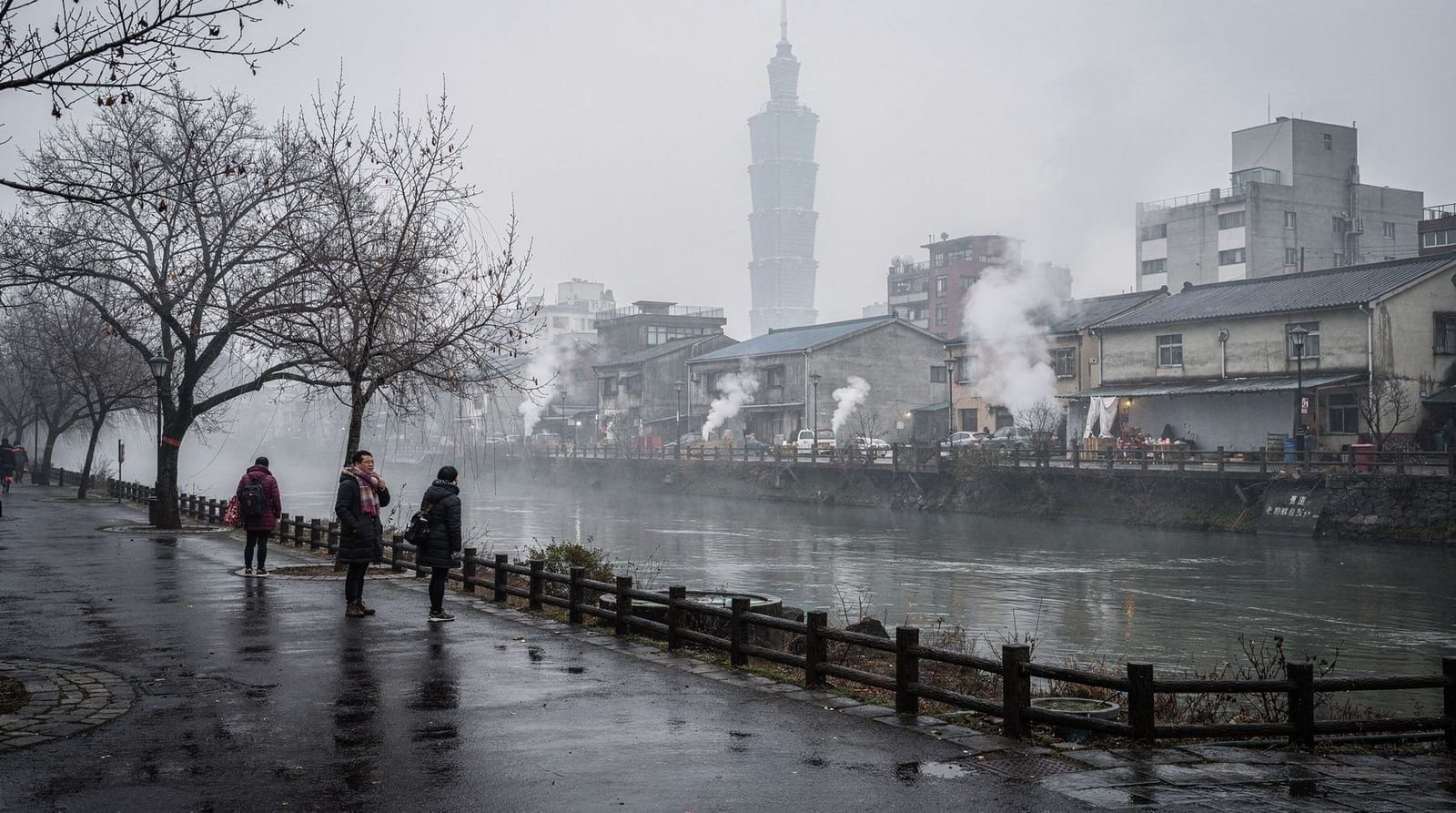
You get a day or two of rain, wind, and grey skies. Some outdoor activities may be cancelled or less pleasant. No typhoon holiday is declared. Day trips may still run. This is the most common outcome — Taipei gets “influenced” by typhoons more often than it takes a direct hit.
Scenario 2: Land warning issued, typhoon holiday declared
All outdoor sightseeing cancels. You’ll spend 1–2 days in your hotel, eating convenience-store food or hotel restaurant meals. This is genuinely inconvenient but not dangerous if you’re in a central city hotel. Outdoor day trips (Jiufen, Yangmingshan, Taroko, etc.) will be cancelled.
Scenario 3: Direct typhoon landfall on northern Taiwan
Rare — perhaps once every few years for a major storm hitting Taipei directly. Wind can be significant (80–130+ kph), flooding occurs in low-lying areas (particularly Wanhua, Beitou). Travel is genuinely unsafe for 12–24 hours. Stay in your hotel; the building will be sound. This passes within 24–36 hours. Aftermath: flooding, debris, some infrastructure damage, but rapid cleanup usually follows.
Monitoring typhoons: the tools that work
Central Weather Bureau (CWB) — cwb.gov.tw The authoritative source. English-language typhoon forecast pages available. Updated every 6 hours when a typhoon is active.
Tropical Storm Risk (TSR) / Joint Typhoon Warning Center (JTWC) English-language agencies that track Northwest Pacific systems. Useful for longer-range forecasts (5–7 days).
Your hotel Reputable hotels in Taipei will alert guests of incoming typhoon warnings and advise whether to stock up on food the night before a typhoon holiday.
Taiwan’s outdoor Facebook communities Groups like “Hiking Taiwan” and regional groups post rapid updates during typhoon approaches. Faster than official sources for ground-level conditions.
Should you cancel your trip if a typhoon is coming?
This depends on timing and your flexibility:
- Storm is still 5+ days away: Do not cancel. Typhoon forecasts at 5 days are notoriously unreliable. The storm may shift direction entirely.
- Storm is 3 days away, heading for Taiwan: Start monitoring closely. Begin identifying what might need rescheduling or cancelling. Contact tour operators about their typhoon policies.
- Land warning issued for Taipei: Assume 1–2 days of closures. Recheck your flight with your airline; some carriers offer penalty-free rebooking during typhoon warnings.
- Direct hit appears certain: Talk to your airline about options. Flight cancellations are common when a major typhoon makes landfall.
Travel insurance note: Many standard travel insurance policies cover typhoon-related delays and cancellations. Read the fine print — “travel disruption” coverage differs from basic trip cancellation coverage. Buy insurance that specifically mentions “natural disaster” or “weather disruption.”
Day trips and typhoon risk
Day trips out of Taipei are the activities most affected by typhoon season:
- Jiufen and Shifen — mountain roads close during strong wind warnings. Tour operators cancel automatically with land warnings.
- Yehliu Geopark — coastal location, closes even on sea warnings. Strong winds make the rock formations genuinely hazardous.
- Yangmingshan — hiking trails close with any significant wind warning; the mountain is exposed.
- Taroko Gorge — particularly vulnerable to typhoon-related landslides. Roads can close for days or weeks after a major storm. If visiting July–September, get trip cancellation insurance specifically for Taroko.
- Maokong Gondola — suspended during strong winds; announced same day.
The summer heat factor alongside typhoons
Even when no typhoon is active, July and August in Taipei are hot and humid. Temperatures reach 33–36°C; the urban heat island effect pushes the feels-like temperature significantly higher. This is separate from typhoon risk but compounds it: summer in Taipei is both hot and typhoon-vulnerable.
Practical strategies for summer visits:
- Schedule outdoor activities (hiking, day trips) before 9 am or after 5 pm.
- Use air-conditioned spaces (MRT, malls, museums, convenience stores) liberally — this is not considered unusual in Taipei.
- Carry a reusable water bottle and refill frequently.
- Apply high-SPF sun protection; UV index in Taipei in summer regularly reaches 10–12 (very high).
Typhoon season budget: the only real upside
Hotels and flights in July–August are cheaper than October–November, often by 20–35%. If your dates are fixed, the budget savings can be meaningful. Accept the risk of 1–2 disrupted days as a trade-off.
| Month | Average mid-range hotel (double) | Typhoon risk |
|---|---|---|
| July | TWD 2,000–3,500 (~€55–95) | High |
| August | TWD 2,000–3,500 (~€55–95) | High |
| September (early) | TWD 2,200–3,800 (~€60–105) | Moderate |
| September (late) | TWD 2,800–4,500 (~€75–125) | Declining |
| October | TWD 4,000–7,000 (~€110–190) | Very low |
Ghost Month: the cultural variable
August typically overlaps with the 7th lunar month (Ghost Month, 鬼月). This is not typhoon-related but affects travel behaviour: some Taiwanese travelers avoid major travel during Ghost Month, which can paradoxically reduce domestic crowds at tourist sites. Some businesses post signs discouraging certain activities (swimming, hiking at night). As a foreign visitor, you don’t need to observe Ghost Month restrictions, but understanding the context helps.
What to pack for a typhoon-season visit to Taipei
- Packable rain jacket — essential; folded into a day bag at all times.
- Compact umbrella — a good windproof one; cheap umbrellas invert in typhoon-adjacent winds. Convenience stores sell emergency umbrellas for TWD 50–100.
- Flip-flops or water-resistant sandals — streets flood in heavy rain; you’ll be wading through puddles.
- Dry bags or waterproof phone case — protect electronics on rainy days.
- Emergency food — not dramatic, but keeping a day’s worth of snacks in your room means a typhoon holiday doesn’t mean going hungry if the hotel restaurant is closed.
See our full Taipei packing guide.
Final verdict on visiting during typhoon season
July–August: possible but not recommended unless budget constraints are significant. The heat and typhoon risk together make for a genuinely harder trip. Build 2 days of contingency into your itinerary, get comprehensive travel insurance, and focus on indoor activities (food, museums, urban exploration) rather than day trips.
September: improving rapidly. First half of September retains meaningful typhoon risk; second half is much more reliable. Late September is excellent value — lower prices than October with weather approaching October quality.
June: manageable. Typhoon risk exists but is lower than July–August. The bigger challenge is plum rain season (persistent drizzle). Not the worst time to visit if airfares are particularly cheap.
For the full annual calendar including all other seasons, see our best time to visit Taipei guide.
What to do if you’re stuck in your hotel for a day
A declared typhoon holiday doesn’t have to be wasted. Central Taipei has genuine indoor options within walking distance of most hotels: the National Palace Museum (see our museum guide) typically stays open unless the warning is severe — check its website the morning of, since museum closure decisions sometimes lag the general typhoon-holiday announcement.
Shopping malls (Taipei 101 Mall, SOGO, Breeze) usually remain open with reduced hours, and their basement food courts are a reliable meal option when street restaurants are shuttered. If your hotel is in Ximending or Daan, a covered arcade or department store is rarely more than a 10-minute walk away.
Rebooking day trips around a typhoon
If a land warning cancels your planned Jiufen and Shifen day, most reputable tour operators offer a free reschedule to the next available date rather than a straight refund — ask directly rather than assuming a cancellation policy applies. If your remaining days are limited, prioritize rebooking the day trip you care about most first, since operators fill alternate dates quickly once a typhoon holiday is announced citywide.
Private Jiufen and Shifen day tour with flexible reschedulingChoosing where to stay with typhoons in mind
If your dates fall in peak season, the neighbourhood matters more than the star rating. A hotel close to an MRT station and a convenience store lets you manage a closure day without ever needing a taxi. Our where to stay in Taipei guide compares areas, and the neighbourhoods guide helps you picture what is within walking distance of each. Districts like Xinyi put malls and food courts at your doorstep, which is a real comfort when the street stalls are shuttered.
Low-lying areas are the ones to think twice about when a major storm is forecast, since flooding tends to start there first. Ask your hotel how it handles heavy rain before you book, and keep your essentials off the floor if you do end up in a ground-floor room.
Moving around when the weather turns
Public transport is usually the first thing to recover once a storm passes, so it pays to know how it works before you need it. The MRT guide explains the system, and the EasyCard guide covers the card that also pays in convenience stores, which you will be visiting often on a closure day. If you are arriving or leaving during a warning, read the Taoyuan airport to Taipei guide so you know your options when schedules shift, and check the HSR guide before planning any onward rail trip, since services can be suspended during the worst of a storm.
Rainy-day plans that actually work
The point of a contingency day is to have somewhere good to go. Rotate between a few reliable indoor options rather than improvising on the day:
- Browse the collections at the best museums in Taipei, keeping the National Palace Museum as your first choice.
- Eat your way through a covered meal, such as soup dumplings at the places in our Din Tai Fung and xiaolongbao guide.
- Spend an afternoon over tea and a slow pot, following the tea culture guide or the bubble tea guide.
- Visit a temple once the rain eases; the Longshan Temple guide covers one of the most atmospheric in wet weather.
- If hot water appeals, the Beitou hot springs guide is worth a read, but check conditions first because the area is prone to flooding.
For more ideas on making the most of grey skies, the blog post on Taipei in the rain has a warmer, more personal take, and the 3-day itinerary is easy to reshuffle so that outdoor stops move to the clearest day.
Reading the forecast like a local
Locals treat typhoon news with calm attention rather than alarm. They check the forecast, stock up modestly, and wait for the official announcement. Do the same: avoid panic-buying, follow your hotel’s advice, and keep your phone charged. Once the warning is lifted, the city tends to return to normal quickly, and the first clear morning after a storm can be a lovely time to be out, with cooler air and sharper views. If you would rather skip the risk entirely, the Taipei in winter guide shows what the quieter season offers instead.